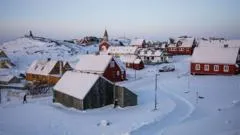
The United States, Denmark, and Greenland have signed a landmark defence agreement to establish two new US military bases in the Arctic territory. This deal, signed at the UN General Assembly in New York, allows Washington to develop a larger military presence at Narsarsuaq and Mestersvig while explicitly reaffirming Denmark's sovereignty and Greenland's right to self-determination. The pact updates a 1951 agreement and aims to bolster NATO security in a strategically vital region. This article examines the specifics of the new bases, the geopolitical implications for Arctic stability, and the resolution of recent diplomatic tensions.
What are the specifics of the new US military bases in Greenland?
The new defence agreement authorizes the United States to establish an additional Defence Area at two specific locations: Narsarsuaq in the south and Mestersvig in the east. These sites represent a significant expansion of the American footprint in the Arctic, moving beyond the existing operations at the Pituffik Space Base in the northwest.
Narsarsuaq, a location with a history as a World War II base and a former civilian airport, offers strategic advantages including deep-water access and a large runway. The US North Command recently confirmed that military engineers have been surveying this site. In contrast, the Mestersvig outpost is a much more remote and less developed area, currently utilized by a Danish naval dog sled unit.
Technical implementation and oversight
While the locations are identified, the precise technical details and modalities of these bases remain to be finalized. Crucially, the agreement stipulates that these arrangements must be mutually agreed upon by all three parties. This mechanism ensures that US security operations are not unfettered; both Greenland and Denmark retain the authority to approve specific implementation plans, maintaining a level of collaborative control over their territory.
How does the deal impact Arctic security and NATO?
The agreement serves as a strategic reinforcement of NATO's presence in the North Atlantic, particularly as the security situation in the Arctic continues to evolve. By formalizing a larger US presence, the deal aims to advance stability and cooperation in a region that is increasingly viewed as a focal point for global power competition.
A key provision of the pact is the explicit exclusion of non-NATO entities from Greenlandic territory. The deal states that no state outside of the NATO alliance shall be permitted to establish manned or unmanned military installations in Greenland, nor are they allowed a persistent military presence. While such access was unlikely to have been granted previously, the formalization of this rule provides a clear legal deterrent against the encroachment of adversaries like Russia or China.
The agreement also provides long-term security guarantees for Greenland's political future. It explicitly confirms that should Greenland achieve independence from Denmark, the territory would remain a member of NATO. This clause provides a level of geopolitical continuity that addresses the concerns of both local leaders and international allies regarding the stability of the Arctic's political landscape.
Why was this agreement necessary after recent diplomatic tensions?
The signing marks the resolution of a period of intense friction caused by previous rhetoric regarding the ownership of Greenland. For over a year, tensions escalated following suggestions from US President Donald Trump that the United States might seek to acquire or annex the semi-autonomous territory, citing its strategic location and significant mineral wealth.
These earlier statements prompted significant backlash from various stakeholders. Greenlandic, Danish, and European leaders issued a joint statement warning that such rhetoric threatened to undermine transatlantic relations and could trigger a dangerous downward spiral in international cooperation. The new deal functions as a diplomatic pivot, moving away from the threat of acquisition toward a framework of strengthened partnership and mutual respect for sovereignty.
The deal effectively serves as an update to the original 1951 defence agreement between Denmark and the US. While the 1951 pact allowed for the deployment of US troops, the 2026 agreement modernizes the relationship to meet contemporary security challenges while providing the legal clarity that was missing during the recent period of uncertainty.
What are the political implications for Denmark and Greenland?
For the leadership in Copenhagen and Nuuk, the deal is being presented as a victory for diplomacy and sovereignty. Danish Prime Minister Mette Frederiksen has described the agreement as a "milestone" in a long-standing cooperation that respects the territorial integrity of the Kingdom of Denmark and the self-determination of Greenland.
Greenlandic Prime Minister Jens-Frederik Nielsen emphasized that the deal was a "win-win-win" scenario that specifically accounts for the rights and livelihoods of the Greenlandic people. For a population of approximately 56,000, the agreement provides a sense of security, ensuring that their territory is central to North American and transatlantic security without sacrificing their political autonomy.
However, the deal is not yet a finished legal reality. It must still undergo the formal approval processes within both the Danish and Greenlandic parliaments. While several political parties in Denmark have already signaled their support, the legislative phase will be the final hurdle in turning this diplomatic agreement into operational military reality.
Will the US 'Golden Dome' project be included in the deal?
Despite the strategic focus on missile defense and Arctic security, the agreement does not contain a concrete proposal for the "Golden Dome" defence system previously mentioned by President Trump. The project, which was described as a futuristic shield against missile attacks, was only mentioned once in the context of the deal.
The primary focus of the current pact remains the expansion of physical infrastructure and personnel presence in the Arctic. While the strategic intent of the US involves countering potential threats from adversaries, the specific technological and structural components of a "Golden Dome" remain separate from the immediate logistical and territorial agreements reached in New York.
Frequently asked questions
What specific locations will host the new US bases?
The new US military installations will be located at Narsarsuaq, in southern Greenland, and Mestersvig, in the east. Narsarsuaq offers significant infrastructure like a large runway and deep-water access, while Mestersvig is a more remote outpost currently used by Danish naval units.
Does the US now own any part of Greenland?
No, the agreement explicitly recognizes the sovereignty and territorial integrity of the Kingdom of Denmark. It also affirms Greenland's right to self-determination, ensuring that no territory is ceded to the United States through this defence pact.
What happens to Greenland's NATO status if it becomes independent?
The agreement includes a specific provision stating that Greenland would remain a member of NATO even if it were to gain full independence from Denmark. This ensures that the region remains under the NATO security umbrella regardless of its political status.
Can non-NATO countries build military sites in Greenland?
The new deal explicitly prohibits any state that is not a member of NATO from establishing manned or unmanned military installations in Greenland. It also prevents non-allied nations from maintaining a persistent military presence on the island.
Is the agreement already in effect?
The deal has been signed by the leaders of the US, Denmark, and Greenland, but it is not yet fully implemented. It must still be officially approved by the parliaments of both Denmark and Greenland before it becomes law.
Key takeaways
- The US will build two new military bases in Greenland at Narsarsuaq and Mestersvig.
- The deal reaffirms Danish sovereignty and Greenland's right to self-determination.
- Non-NATO nations are explicitly barred from establishing military presences in Greenland.
- Greenland is guaranteed NATO membership even if it achieves independence from Denmark.
- The agreement updates the original 1951 defence pact between the US and Denmark.
Conclusion
The 2026 defence agreement represents a significant realignment of Arctic geopolitics, shifting from a period of diplomatic tension to one of structured military cooperation. By establishing new bases at Narsarsuaq and Mestersvig, the United States strengthens its strategic posture in the North Atlantic while operating within a framework that respects the sovereignty of Denmark and the autonomy of Greenland. As the deal moves toward parliamentary ratification, it sets a new precedent for how NATO allies manage territorial security and regional stability in an increasingly contested Arctic environment.