The US media ban on specific outlets has triggered a widespread suspension of pooled presidential coverage by major television networks. Following the White House's decision to bar CNN, Politico, and MS NOW from the premises, several news organisations have halted their participation in shared broadcasting duties. This move comes after President Donald Trump accused these outlets of publishing biased reports. The decision to withdraw from the pool aims to protest the restriction of access to the administration, marking a significant escalation in the ongoing tension between the executive branch and the press.
Why did major US networks suspend their coverage of President Trump?
Major US television networks suspended their shared coverage of President Trump on Monday as a direct protest against the White House's decision to bar specific media organisations from the building. The suspension follows the administration's move to revoke the credentials of CNN, Politico, and MS NOW, which the outlets claim was done without prior notice or due process.
The decision to halt coverage is a collective response to what media organisations describe as an attempt to control the narrative. By withdrawing from the shared pool, networks are signaling their opposition to the administration's actions. This protest has had immediate visible consequences for news broadcasting, including the absence of network television footage during significant presidential movements, such as the President's arrival in New York for the UN General Assembly and his boarding of Air Force One.
The impact on visual news reporting
The suspension of the pool has created a significant gap in the visual record of the presidency. Because the pool is designed to provide shared footage to save costs and space, its absence means that many major networks no longer have access to the standard video feeds of presidential activities. This was evidenced by the lack of footage during the President's recent travels and public appearances, leaving a void that the administration attempted to fill with its own proprietary media tools.
How does the White House press pool function and why is it in crisis?
The White House press pool is a collaborative arrangement where various media organisations share resources, including reporters, camera crews, and footage, to cover presidential events efficiently. This system is intended to ensure that the American public receives coverage of the President's activities while managing the logistical constraints of space and the high costs associated with deploying multiple independent crews to every single event.
The current crisis stems from the breakdown of this cooperative model. When the White House barred three specific outlets, it effectively disrupted the mechanism that allows the pool to function. According to Bryan Boughton, the Fox News Washington bureau chief, the TV pool ceased covering designated events because the White House prevented CNN from fulfilling its specific pool duties. This disruption has led to a situation where, as Boughton noted in an email seen by the BBC, "there will be no replacement pool put in place" for the time being.
What are the legal arguments behind the media lawsuits?
CNN, Politico, and MS NOW have filed a lawsuit in US District Court in Washington to challenge the administration's decision to revoke their journalists' credentials. The core of the legal argument rests on the principle of press freedom and the protection of independent journalism from government interference. The plaintiffs contend that the White House's actions constitute a direct attempt to decide what the press is permitted to report.
In a joint statement regarding the legal action, the three organisations argued that the revocation of credentials occurred "without notice or process" and was motivated by the administration's objection to their specific reporting. The lawsuit seeks to establish that the government cannot use credentialing as a tool for censorship. The organisations maintain that if such actions go unchallenged, they pose a fundamental threat to the public's right to access independent news that is not curated or controlled by the sitting administration.
The administration's defense and accusations
President Trump has defended his actions by accusing the targeted organisations of spreading "fiction or lies" regarding his administration. By framing the media's reporting as untruthful, the administration has positioned the ban as a necessary response to misinformation rather than an act of censorship. This rhetoric has been central to the administration's justification for restricting access to the White House.
How is the White House responding to the media boycott?
The White House has responded to the media's protest by launching its own dedicated streaming service, known as Trump TV. This platform provides a 24/7 feed of video clips featuring the President, allowing the administration to bypass traditional news filters and communicate directly with the public. This move represents a shift toward a more controlled, direct-to-consumer model of presidential communication.
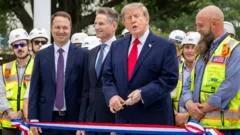
During recent events, such as a ribbon-cutting ceremony for a new Marine One helipad on the White House South Lawn, the administration relied on its own streaming capabilities. However, these efforts have faced technical and qualitative challenges; for instance, during the helipad ceremony, the President's comments were reportedly inaudible on the official stream. Despite the boycott, the President has maintained a public stance of confidence, suggesting that the media's attempt to avoid him has not significantly impacted his ability to engage with the press at large.
What is the broader impact on news accessibility?
The standoff between the White House and major media outlets has created a fragmented information landscape. While the administration uses Trump TV to provide a continuous stream of content, the absence of traditional, independent pool coverage means that the visual and contextual depth of presidential reporting is being diminished. Other major outlets, including the New York Times and the Washington Post, have also joined the protest by refusing to share still images from Trump events.
This fragmentation means that different segments of the public may receive vastly different versions of the same event. One group may see the President through the lens of the administration's direct feed, while another may only receive reports from outlets that are actively protesting the administration's policies. This divide complicates the role of the press as a neutral observer and increases the difficulty for citizens to access a comprehensive and unmediated view of government activities.
Frequently asked questions
What is the White House press pool?
The White House press pool is a system where different news organisations share reporters and video footage to cover the President. This method is used to manage the high costs of broadcasting and the limited physical space available during official presidential events and travels.
Which media outlets are currently banned from the White House?
CNN, Politico, and MS NOW are the three primary organisations that have been barred from the White House. These outlets have filed a lawsuit in US District Court to challenge the administration's decision to revoke their journalists' credentials.
Why did the networks stop their shared coverage?
Networks suspended their pooled coverage as a protest against the administration's ban on certain journalists. By withdrawing from the pool, these organisations are attempting to defend the principle of press freedom and protest government interference in journalism.
What is Trump TV?
Trump TV is a 24/7 streaming channel launched by the White House. It provides a continuous feed of video clips featuring the President, serving as a direct communication tool to bypass traditional media outlets and provide the administration's own perspective.
Has the President commented on the media boycott?
Yes, President Trump has expressed confidence regarding the boycott. He suggested that the media's attempt to avoid him would not be effective, noting that there was still a significant press presence at subsequent appearances, such as his meeting with the Mayor of New York.
Key takeaways
- CNN, Politico, and MS NOW have filed a lawsuit against the Trump administration over credential revocations.
- Major US networks suspended pooled coverage to protest the White House media ban.
- The White House launched Trump TV to provide a 24/7 direct feed of presidential clips.
- The media boycott resulted in a lack of network footage for several major presidential events.
The evolving landscape of presidential communication
The current conflict between the Trump administration and major media organisations marks a significant shift in how the presidency is communicated to the public. The move toward direct-to-consumer platforms like Trump TV, combined with the active restriction of traditional press credentials, challenges the long-standing role of the media as an independent intermediary. As legal battles unfold in US District Court, the outcome will likely define the boundaries of press freedom and the extent to which a government can regulate access to its officials in the digital age.