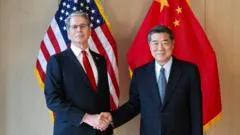
An AI safety plan involving a new notification mechanism for national security incidents is being discussed by US and Chinese officials. Following recent meetings in New York, Treasury Secretary Scott Bessent indicated that transparency between the world's leading AI powers is a top priority. This diplomatic movement occurs as President Donald Trump and President Xi Jinping prepare for a high-stakes summit in Washington later this week. The discussions aim to establish protocols that prevent accidental escalations between the two superpowers during this period of rapid technological advancement.
Establishing a notification mechanism for AI incidents
Top officials from the United States and China are exploring the creation of a formal "notification mechanism" to manage artificial intelligence incidents that might impact national security. This proposal emerged following high-level discussions in New York between US Treasury Secretary Scott Bessent and Chinese Vice Premier He Lifeng. The goal is to mitigate risks associated with the rapid advancement of AI technology through structured communication.
According to Scott Bessent, moving from an opaque environment to one defined by transparency is essential for the two dominant global AI powers. The proposed mechanism would allow both nations to alert one another regarding technological developments or malfunctions that could have cross-border security implications. This shift toward formal communication aims to reduce the risk of accidental escalation in a sector where both countries are competing for technological supremacy.
The discussions come at a time of heightened scrutiny regarding AI. Researchers have recently issued warnings about the potential risks posed by advanced models, while prominent industry figures have advocated for a more cautious development trajectory. By establishing a protocol for incident reporting, the US and China hope to address these safety concerns while maintaining their competitive edge.
Diplomatic groundwork ahead of the Trump-Xi summit
The recent talks in New York serve as a critical precursor to the upcoming summit between US President Donald Trump and Chinese President Xi Jinping in Washington. These preliminary meetings are designed to set the stage for direct dialogue between the two heads of state on complex technological and economic issues.
According to Chinese state news agency Xinhua, the discussions between Bessent and He Lifeng were "candid, in-depth and constructive." While the Chinese side focused on the importance of exchanging views on economic and trade issues, they explicitly confirmed that artificial intelligence was a central topic of the meeting. This alignment suggests that both nations recognize AI as a pillar of future bilateral relations.
The diplomatic context is further complicated by the ongoing race for AI dominance. While some in Washington have called for a slowdown in AI development to protect human interests, President Trump has maintained a stance that emphasizes maintaining the US technological lead. He has argued that existing policies are sufficient to manage the risks without sacrificing the country's competitive advantage against China.
Economic stability and the Board of Trade
Beyond the immediate concerns of AI safety, the bilateral talks addressed critical economic frameworks intended to stabilize trade relations. A significant portion of the meeting focused on "operationalising" the Board of Trade, a process designed to identify and implement potential tariff cuts on various goods.
The urgency of these economic discussions is driven by the approaching expiration of a tariff truce between the world's two largest economies on 10 November. Finding a way to manage trade tensions through the Board of Trade could provide much-needed stability for global markets. Bessent noted on social media that these efforts are intended to help advance American economic interests and deliver tangible results for the US population.
This economic cooperation mirrors previous attempts at bilateral agreements. In May, during a meeting in Beijing, discussions between Trump and Xi resulted in an arrangement where China committed to purchasing Boeing aircraft and US agricultural products in exchange for reduced tariffs. The current focus on the Board of Trade suggests a move toward more institutionalized methods of managing trade disputes and tariff structures.
The intersection of technology and trade policy
The dual focus on AI safety and tariff management highlights the inseparable nature of technology and geopolitics in the modern era. As the US and China navigate the complexities of AI regulation, they must simultaneously manage the economic friction caused by trade wars and technological competition.