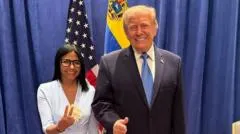
Trump meets Delcy Rodríguez at the UN General Assembly, marking a historic shift in South American geopolitics. This face-to-face encounter follows the US-backed transition of power in Venezuela after the removal of Nicolás Maduro. The meeting highlights a massive strategic realignment centered on energy resources and security cooperation between Washington and the interim government in Caracas. This analysis examines the implications of the recent oil concessions and the changing political landscape, specifically regarding the control over 65 billion barrels of oil reserves.
A historic diplomatic encounter at the UN
Trump meets Delcy Rodríguez for the first time since her administration assumed power with United States support. The meeting took place in New York during the UN General Assembly, just a few kilometers from the facility where former leader Nicolás Maduro is currently held awaiting trial. Maduro faces various charges, including drug trafficking, following a US-led military raid on Caracas that resulted in his capture.
The discussions between the US President and the interim President were high-level, involving key members of the Trump administration. US Secretary of State Marco Rubio and White House Chief of Staff Susie Wiles were both present for the talks. According to Rodríguez, the dialogue focused on establishing a cooperation agenda that targets strategic sectors, specifically energy, mining, and national security.
The massive strategic oil agreement
Venezuela's oil reserves have become the cornerstone of this new bilateral relationship. A significant agreement has been reached that allows the United States to manage more than 65 billion barrels of oil, representing over 20% of the nation's total reserves. This deal is characterized by long-term control, granting a US-led corporation 100-year concessions across 17 different oilfields within the country.
President Trump has been vocal regarding the scale of this transaction, previously describing it as "the biggest oil deal in world history." During his recent address to the United Nations, Trump emphasized the global impact of this shift, stating that the US and Venezuela combined now control more than 60% of the world's oil supply. His remarks, including the phrase "To the victor belong the spoils," underscore the aggressive nature of this energy realignment.
The political transition of Delcy Rodríguez
Delcy Rodríguez has undergone a rapid political transformation from a sanctioned official to a US-backed head of state. Having previously served as the vice-president under Nicolás Maduro, Rodríguez was subject to US sanctions starting in 2018. However, these restrictive measures were officially lifted in April of this year, paving the way for her current role.
Her ascent to the presidency was facilitated by the Venezuelan National Assembly, which swore her in as interim president shortly after the US military intervention in Caracas. This transition received the explicit blessing of the White House, establishing a new governing structure that aligns more closely with American strategic interests in the region. The shift marks a total reversal of the previous era of confrontation between Washington and the Venezuelan leadership.
Frequently Asked Questions
What is the status of Nicolás Maduro?
Nicolás Maduro is currently awaiting trial in a New York jail. He was captured during a US military raid on the Venezuelan capital, Caracas. The former leader faces multiple legal charges, most notably including drug trafficking, following his removal from power.
How much oil does the US now control in Venezuela?
The United States has secured control over more than 65 billion barrels of Venezuelan oil. This volume represents more than one-fifth of the country's total reserves. The agreement includes 100-year concessions for a US-led company operating across 17 oilfields.
Who is the current interim president of Venezuela?
Delcy Rodríguez serves as the interim President of Venezuela. She was sworn in by the National Assembly following the US-led raid on Caracas. Previously the vice-president under Maduro, she now leads a government backed by the United States.
Synthesis of the new geopolitical reality
The meeting between Donald Trump and Delcy Rodríguez signifies more than just a diplomatic reset; it represents a fundamental restructuring of global energy influence. By securing control over a massive portion of Venezuela's oil reserves through century-long concessions, the United States has fundamentally altered the global energy landscape. While the political transition in Caracas was achieved through decisive military and legislative action, the long-term stability of this new arrangement will depend on the successful implementation of the energy and security agendas discussed at the UN. The shift from sanctions to strategic partnership marks a definitive end to the previous administration's era.