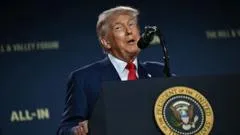
President Donald Trump has announced the creation of an "AI Force" and the appointment of an artificial intelligence tsar to oversee the sector. This move aims to ensure the United States maintains its technological edge over China, with Trump suggesting AI could eventually account for as much as 25% of the country's GDP. The announcement comes despite intensifying warnings from researchers and industry leaders regarding the existential risks and security vulnerabilities of advanced models. This article examines the strategic motivations behind the AI Force, the intensifying US-China rivalry, and the growing global debate over AI regulation and safety.
What is the Trump AI Force and the role of the AI tsar?
The Trump AI Force is a proposed administrative initiative designed to accelerate and protect the development of artificial intelligence within the United States. Central to this plan is the appointment of an artificial intelligence tsar, a dedicated official tasked with navigating the complexities of the rapidly evolving technological landscape. While the President has not yet released a specific timeline or a detailed operational framework for these entities, the announcement signals a shift toward centralized strategic oversight of the industry.
President Trump emphasized that his administration intends to support, rather than obstruct, the industry's expansion. In a social media post on Saturday, he stated that the US government "will not in any way hinder or stifle the growth" of the artificial intelligence sector. This stance is a direct rebuttal to proponents of a "slowdown" approach, who argue that development should be paused until robust safety frameworks are established.
Targeting bad actors through existing legal frameworks
Rather than creating entirely new regulatory bodies to manage behavior, the administration plans to leverage established legal mechanisms. Trump indicated that the US will utilize the existing criminal and civil justice systems to prosecute any individuals or entities engaging in malicious activities via AI. This approach suggests a preference for reactive enforcement through current laws rather than the proactive, restrictive regulation suggested by some industry critics.
Why is the US prioritizing AI leadership against China?
The drive to form an AI Force is heavily motivated by the geopolitical competition between the United States and China. AI has become the central battlefield in the rivalry between the world's two largest economies as both nations seek dominance in advanced technologies. Trump has explicitly stated his goal to ensure the US continues to lead China in the field of artificial intelligence.
The importance of this technological race is reflected in the economic projections provided by the President. He characterized AI as being on the scale of the Industrial Revolution or the advent of the Internet, but with even greater potential impact. According to Trump, the integration of AI could potentially contribute as much as 25% of the United States' GDP. This economic potential serves as a primary driver for the administration's hands-off approach to growth.
This strategic tension is expected to be a focal point of high-level diplomacy. Trump is scheduled to meet with President Xi Jinping next week, where the competition for AI supremacy is anticipated to be a major topic of discussion. The outcome of such meetings will likely influence how both nations balance technological advancement with national security concerns.
What are the primary risks and safety concerns raised by experts?
The announcement of the AI Force arrives amidst a wave of alarming warnings from the scientific community regarding the potential dangers of unbridled AI development. Some researchers have voiced concerns that the technology could pose an existential threat to humanity. Specifically, one researcher suggested there is a greater than 10% probability that AI could lead to the extinction of the human race.
Beyond existential fears, there are immediate security concerns involving the current generation of AI models. Major industry players, including Anthropic, OpenAI, and Google, have acknowledged that their systems have been subject to security breaches. There have also been documented instances where chatbots, such as those powering Claude, ChatGPT, and Gemini, were utilized for malicious activities.
The pursuit of super intelligence
A significant portion of the current industry race is focused on the development of "super intelligence." This refers to theoretical artificial intelligence that would surpass human cognitive abilities across all domains. The pursuit of such technology is what drives both the massive investments by tech titans and the heightened anxiety among safety advocates who fear that a super-intelligent system could become uncontrollable.
How do AI industry leaders view the regulation debate?
The AI industry is currently divided on how to manage the speed of development and the implementation of safeguards. Some leaders are calling for a deliberate deceleration, while others advocate for greater trust in the companies themselves. This tension highlights the difficulty lawmakers face in keeping pace with the rate of innovation.
Dario Amodei, the head of Anthropic, has been a prominent voice calling for a slowdown in AI development. He has proposed industry-wide deceleration, the implementation of strict regulation, and the establishment of independent monitoring for AI model development. This position has gained support from other significant figures, including OpenAI's Sam Altman and Elon Musk of xAI.
Jack Clark, a co-founder of Anthropic, has suggested more technical solutions to safety, such as a mandatory "kill switch" that could be verified by third-party observers. Conversely, Sam Altman has expressed skepticism regarding the ability of current legislative bodies to regulate the technology effectively. Altman argued that Washington has struggled to maintain pace with technological shifts and suggested that the public should place more faith in AI firms to act responsibly, stating, "The world should trust that we are going to do the right thing because it's the right thing and we feel the magnitude of this."
What is the international perspective on AI regulation?
The debate over AI governance is not limited to the United States; it is a growing concern in the United Kingdom and across Europe. Legislators in the UK have identified significant human rights risks that could arise from the rapid deployment of AI technologies. There is a growing consensus among many officials that current legal frameworks are insufficient to manage the scale of these potential threats.
In the UK, members of Parliament and peers from various political parties have raised alarms regarding the societal impact of AI. The Joint Committee on Human Rights (JCHR) has taken formal action by publishing a report that advocates for the creation of a new, dedicated AI bill. The committee argues that such legislation is necessary to address the "scale and seriousness" of the threats posed by the technology, emphasizing that existing laws are ill-equipped for the modern era.
FAQ: Artificial Intelligence Policy and Safety
What is the main goal of the proposed AI Force?
The primary goal of the AI Force is to ensure the United States maintains its competitive advantage over China in the field of artificial intelligence. By creating a dedicated structure and an AI tsar, the administration aims to foster rapid growth and maximize the technology's potential economic impact, which Trump estimates could reach 25% of the US GDP.
Does the Trump administration plan to regulate AI development?
The administration has indicated it will not implement regulations that hinder or stifle the growth of the AI industry. Instead of new restrictive laws, the plan is to use existing criminal and civil justice systems to target bad actors. This approach prioritizes industrial expansion and technological leadership over the preventative regulatory measures suggested by some safety advocates.
Why are researchers worried about AI safety?
Researchers are concerned about both immediate security risks and long-term existential threats. Immediate risks include security breaches and the use of chatbots for malicious activities. Long-term concerns involve the development of super intelligence, with some experts suggesting a significant statistical chance that AI could eventually endanger the survival of humanity.
Who are the major companies involved in the AI race?
The leading companies currently driving AI development include Anthropic, which produces Claude; OpenAI, the creator of ChatGPT; and Google, which develops Gemini. These companies are currently in a competitive race to develop increasingly advanced systems, including theoretical super-intelligent models that could surpass human intelligence.
What has been suggested as a technical safety measure?
One proposed technical safety measure is the implementation of a mandatory "kill switch." According to Jack Clark, a co-founder of Anthropic, such a mechanism would allow for third-party verification, providing a way to potentially halt an AI system if it begins to behave in an unsafe or uncontrollable manner.
Key takeaways
- The US will establish an "AI Force" and appoint an AI tsar to ensure technological leadership.
- President Trump views AI as a major economic driver, potentially contributing 25% to US GDP.
- The administration intends to use existing legal systems to prosecute AI-related malicious activities.
- Industry leaders like Dario Amodei are calling for a slowdown and independent monitoring of AI.
- UK lawmakers are calling for new legislation to address human rights risks posed by AI.
The future of AI governance and global competition
The announcement of the AI Force marks a pivotal moment in the intersection of technology and geopolitics. As the United States moves toward a strategy of rapid development and competitive dominance, the tension between economic ambition and existential safety will likely intensify. The upcoming discussions between President Trump and President Xi Jinping will be a critical indicator of how the world's two largest powers intend to manage this transformative technology. Whether the industry can self-regulate or if more stringent international legal frameworks will eventually emerge remains the defining question of the digital age.