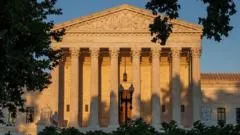
The US Supreme Court has lifted restrictions on the Trump administration's use of a controversial federal database to verify voter citizenship. The ruling allows the Department of Homeland Security to continue using the Systematic Alien Verification for Entitlements (SAVE) programme to identify potential non-citizens on electoral rolls. This decision follows a lower court's finding that the system violated privacy rights. The ruling comes as 27 states currently utilize the system, amid warnings from critics regarding data reliability and the potential for wrongful disenfranchisement of eligible citizens.
What is the Supreme Court ruling regarding the SAVE programme?
The US Supreme Court has overturned previous restrictions that prevented the Trump administration from utilizing a specific federal database to monitor voter citizenship. By lifting these limitations, the top court has cleared the way for the Department of Homeland Security (DHS) to use the Systematic Alien Verification for Entitlements (SAVE) programme to cross-reference voter rolls with citizenship data. The decision specifically addresses the legality of the federal government's role in providing this information to states.
The court's conservative majority determined that the National Voter Registration Act does not prohibit the broad use of such data, even in the period leading up to an election. While the ruling acknowledges the potential for impact on the midterm elections, the court found that the previous injunction hindered the federal government's ability to use a programme it deems essential for maintaining electoral integrity. This decision effectively overrides a June ruling by US District Judge Sparkle L. Soonnan, who had declared the system illegal due to privacy concerns.
The legal foundation of the DHS authority
The Supreme Court's decision rests on the interpretation of a 1996 law. According to the court, this legislation grants the Department of Homeland Security the authority to seek citizenship and immigration data from various federal agencies. Furthermore, the court ruled that these agencies have a legal obligation to respond to requests from states seeking such information. This interpretation provides a significant legal shield for the administration's efforts to verify the eligibility of voters through federal data streams.
Why is the SAVE programme considered controversial?
The SAVE programme is at the center of a heated debate regarding the balance between election security and the protection of individual privacy rights. Originally established in 1986, the database was designed to assist officials in verifying the immigration status of individuals applying for public benefits. However, the Trump administration expanded its scope by allowing bulk searches that leverage sensitive information from Social Security rolls, a move that has drawn intense scrutiny from civil liberties advocates.
Critics argue that the expanded capabilities of the database pose a direct threat to the voting rights of eligible Americans. The primary concern is that the data used for these checks may not be perfectly accurate, leading to the wrongful removal of lawful citizens from voter rolls. The League of Women Voters, a lead plaintiff in the legal challenge, described the Supreme Court's decision as "profoundly disappointing," warning that millions of Americans could be unlawfully targeted by an unreliable database just weeks before midterm elections.
Privacy concerns and judicial opposition
The judicial opposition to the programme's expansion was led by US District Judge Sparkle L. Soonnan. In her June ruling, the Biden-appointee stated that the revamped system showed the federal government "knowingly trampled on the privacy rights" of US citizens. She argued that such actions threaten the "sacred right to vote" by creating a mechanism for mass, potentially erroneous, purges of electoral rolls.
How reliable is the citizenship verification data?
Reliability remains a central point of contention, as evidence suggests the database has produced significant errors in identifying eligible voters. While the administration maintains the system is necessary to prevent non-citizens from participating in elections, real-world applications have highlighted systemic inaccuracies. The discrepancy between the administration's claims of widespread non-citizen voting and the actual recorded instances of illegal voting is a major point of friction.
Data from various states illustrates the potential for error. For instance, in Travis County, Texas, media reports indicated that of nearly 100 voters flagged as non-citizens, at least 10%—and potentially a higher percentage—were actually US citizens. Despite the use of the SAVE system in Texas, only three non-citizen voters have been charged with illegal voting since the state began using the programme last year. This suggests a gap between the number of individuals flagged and the number of actual violations discovered.
State-level implementation and guardrails
The use of the SAVE programme is voluntary for individual states, meaning the level of scrutiny applied to the data varies by jurisdiction. Some states have implemented their own verification processes to mitigate the risk of error. Georgia's Secretary of State, Brad Raffensperger, a Republican, has advocated for the programme while emphasizing the need for rigorous vetting. Raffensperger told the BBC that his office conducts thorough reviews of government-provided data, including interviewing flagged individuals to ensure accuracy. He noted that "guardrails" are in place to prevent the denial of legitimate voting rights.
What is the broader context of electoral reform in the US?
The Supreme Court's decision on the voter database is part of a larger effort by the Trump administration to reform the American electoral system. Since returning to the White House in January of last year, the administration has pursued several initiatives aimed at tightening election protocols. This includes previous attempts to restrict the use of mail-in ballots, though those specific efforts were rejected by the Supreme Court.
The administration and the Department of Homeland Security have frequently suggested that hundreds of thousands of non-citizens are present on voter rolls. However, historical data from states like Texas provides a different perspective. In 2024, Texas Governor Greg Abbott announced that 1,930 individuals with a "voter history" were removed from rolls out of a total of nearly 18 million registered voters. These figures are significantly lower than the estimates provided by the administration, highlighting the ongoing debate over the scale of the issue.
Dissenting opinions and the human cost
The Supreme Court's decision was not unanimous, with three liberal-leaning justices issuing a dissent. Justice Ketanji Brown Jackson expressed deep concern regarding the potential for disenfranchisement. She argued that the harm caused by incorrectly revoking the voting rights of even a few lawful voters outweighs the "non-existent harm" the government suffers when prevented from taking actions it may lack the authority to perform. This dissent underscores the fundamental tension between administrative authority and the protection of constitutional rights.
Frequently asked questions
What is the SAVE programme?
The Systematic Alien Verification for Entitlements (SAVE) programme is a Department of Homeland Security initiative. Originally created in 1986 to verify citizenship for public benefits, it has been expanded to allow states to check the immigration status of individuals on voter rolls to ensure only citizens are registered to vote.
How many states use the SAVE system?
Currently, a total of 27 states utilize the SAVE programme to verify the citizenship status of voters on their electoral rolls. The use of this federal database remains voluntary for each individual state, allowing for different levels of integration and verification rigor across the country.
Why did the Supreme Court overturn the lower court's ruling?
The Supreme Court ruled that a 1996 law mandates that federal agencies respond to state requests for citizenship data. The majority concluded that the previous injunction prevented the federal government from using a programme it deemed appropriate for the task of maintaining accurate voter rolls.
What are the risks associated with the database?
The primary risk is the potential for "false positives," where lawful US citizens are incorrectly identified as non-citizens. Critics and dissenting justices argue that these errors can lead to the unlawful removal of eligible voters from electoral rolls, effectively disenfranchising them during critical election periods.
Has the system been proven to catch non-citizen voters?
While the administration argues the system is necessary, evidence of its efficacy is debated. In Texas, for example, only three non-citizen voters have been charged with illegal voting since the state began using the system last year, despite the database flagging numerous individuals for review.
Key takeaways
- The US Supreme Court lifted restrictions on the Trump administration's use of the SAVE database.
- The SAVE programme allows states to verify voter citizenship using DHS data.
- Critics warn that database inaccuracies could lead to the wrongful disenfranchisement of US citizens.
- The ruling is based on a 1996 law requiring federal agencies to assist states with data requests.
- Currently, 27 states use the system to check voter eligibility.
Conclusion
The Supreme Court's decision to allow the continued use of the SAVE programme marks a significant development in the ongoing struggle over US election integrity and voter rights. While the ruling provides the Trump administration with a powerful tool to verify voter eligibility, it also intensifies concerns regarding privacy and the potential for mass disenfranchisement due to data errors. As the midterm elections approach, the tension between the administration's drive for electoral reform and the protections sought by civil rights groups remains a central theme in the American political landscape.