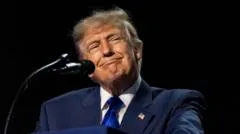
US President Donald Trump proposed giving $5,000 to every adult American if Republicans win the November midterms. Nearly 270 million adults make the total cost approximately $1.3 trillion. Legal experts differ on whether the pledge violates federal rules against payments intended to influence votes. Vice-President JD Vance suggested tariff revenue as a funding source, yet current collections fall well short of the required amount. This article examines the legal arguments, fiscal feasibility and political context behind the offer.
Is the $5,000 offer legal under US law?
Federal statutes prohibit payments made to influence how a person votes. Trump’s proposal, made at a Republican convention in Texas, raised immediate questions because it ties a direct cash amount to an election outcome. Dr Joan Mahoney of the University of Southampton argued the pledge could be viewed as a broad tax-cut commitment rather than a targeted inducement. She noted that the payment would reach every adult regardless of voting record, removing the classic element of a bribe. “On the one hand it sounds a bit like a bribe, vote for the Republicans and you’ll get money, which would be decidedly illegal,” she said. “But on the other hand it would go to everyone, regardless of how they voted so it isn’t in that sense a bribe. I think it would be legal. It’s the same kind of campaign pledge as saying ‘if my party wins we’ll reduce taxes’. Every party does that all the time… and that’s obviously perfectly legal.” Laurel Rapp of Chatham House countered that the explicit transactional framing distinguishes it from ordinary campaign promises. She described the offer as “a very different, very transactional agreement” from the kind of promise usually made by candidates. The distinction matters because standard tax-cut pledges have long been accepted as legal while direct payments conditioned on electoral results have not. What remains unsettled is whether courts would accept the universal framing or focus on the explicit link to the election result. The absence of prior court rulings on identical wording leaves the precise boundary between legal pledge and prohibited inducement open to future litigation.
How much would the payments actually cost?
Official population figures show roughly 270 million American adults. Multiplying that number by $5,000 produces a total outlay of about $1.3 trillion. Congress holds the power of the purse, so any such programme would normally require legislative authorisation. Legal analysts consider it improbable that a president could authorise the sum through executive order alone. Erica York of the Tax Foundation described the proposal as one of the least efficient uses of that scale of funds, given already rising federal deficits linked in part to the war in Iran. “This would be one of the worst ways to use $1.3 trillion,” she said. “We’re on a very unsustainable track, with deficits only projected to grow and grow.” Trump gave no details on funding and did not indicate whether he would seek congressional approval. The absence of a concrete financing plan leaves the fiscal feasibility open to doubt even before political resistance is considered. Without identified revenue streams or spending offsets, the proposal’s impact on the federal deficit trajectory cannot be quantified from available information.
Could tariff revenue cover the cost?
Vice-President Vance pointed to tariffs as the intended funding mechanism. Data compiled by the Bipartisan Policy Center show that tariff and excise tax receipts since the start of 2025 total around $475 billion. More than $100 billion of those receipts have already been refunded following Supreme Court rulings that invalidated several tariff measures. The remaining net revenue remains far below the $1.3 trillion figure. When asked how the payouts could work, the White House stated: “The doomers and naysayers have consistently doubted President Trump. With the continued support of the American people, President Trump will keep delivering real results.” No updated revenue projections or alternative sources were supplied. The gap between existing collections and the required sum therefore stays unbridged by any administration forecast. Historical tariff performance provides no precedent for scaling receipts to the level needed within a single budget cycle.
Why has the offer appeared now?
The midterms are less than two months away. Former Republican strategist Robert Moran described the timing as typical of campaign-season promises whose funding details remain unspecified. “It is an extraordinary promise, and I’m not sure where that money is going to come from – but it is campaign season,” he said. Chatham House analyst Rapp linked the proposal to polling trends showing Republican support softening and Trump’s own approval ratings under pressure. “Money is something that he is now resorting to because the polling is not looking good for Republicans and the polling is not looking good for him,” she continued. In that environment, cash pledges function as short-term tools to retain congressional majorities during the final two years of the presidential term. The offer therefore operates as an immediate electoral signal rather than a fully developed policy plan. Observers note that such pledges often serve to mobilise turnout in the closing weeks without committing detailed legislative blueprints.
Have similar pledges been made before?
Trump previously floated $2,000 payments funded by tariffs; those cheques never materialised. In 2021, President Biden faced accusations of vote-buying when he promised $2,000 Covid stimulus payments contingent on Democratic Senate victories in Georgia. During the 2024 campaign, Elon Musk offered financial incentives to registered voters in swing states who signed a petition. Each episode illustrates the recurring tension between cash offers and election-integrity rules, yet none produced a payout on the scale now proposed. The pattern shows that past pledges of this type have consistently stalled after the relevant elections without delivering the promised sums. No mechanism has yet been demonstrated that converts tariff receipts into direct per-adult payments at the volumes discussed.
Frequently asked questions
Would every adult receive the payment even if they did not vote Republican?
Trump stated the money would go to every adult American, not only Republican voters. The universal framing is central to arguments that the pledge is not a targeted bribe.
Can the president approve $1.3 trillion through executive order?
Legal experts consider this route unlikely. Congressional authorisation is required for spending of this magnitude, and no legislative vehicle has been identified.
Have tariff collections reached the necessary level?
Net tariff revenue since early 2025 stands at roughly $375 billion after refunds, well below the required total. No updated administration forecast has closed that gap.
What happens if Congress refuses to fund the plan?
Without legislative approval the payments cannot proceed. Past tariff-funded proposals stalled at the same hurdle.
Has any comparable payment ever been delivered?
No previous proposal of this size has resulted in actual cheques. Earlier, smaller pledges remained unfulfilled after the elections in question.
Key takeaways
- The proposed payout totals approximately $1.3 trillion based on 270 million adult recipients.
- Legal scholars disagree on whether the pledge crosses into prohibited inducement territory.
- Current net tariff receipts cover less than one-third of the stated amount.
- Congressional approval would be required; no such measure has been introduced.
- Similar past pledges have not resulted in payments.
Conclusion
The $5,000 proposal raises unresolved questions of legality, funding and congressional consent. With midterms approaching, the offer functions as a campaign signal whose practical delivery remains uncertain. Observers will watch whether any legislative or administrative steps follow the November vote.