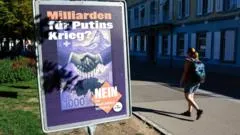
Swiss neutrality remains a flexible concept following a decisive democratic vote in the country. More than 70% of Swiss voters rejected proposals that would have strictly limited the nation's ability to impose sanctions without United Nations approval. This outcome ensures that Switzerland can maintain its current diplomatic stance, including its continued support for sanctions against Russia. The following analysis examines the implications of this vote and the historical evolution of Switzerland's non-aligned status. Furthermore, experts suggest this result preserves the country's ability to act independently in international crises.
Voters uphold flexibility in Swiss neutrality
The Swiss electorate has delivered a clear mandate against a more rigid definition of the nation's long-standing diplomatic tradition. According to official results, over 70% of voters turned down an initiative that sought to restrict Switzerland's capacity to implement sanctions unless they were backed by the UN. This proposal would have fundamentally altered the nation's geopolitical agency by preventing it from pursuing closer ties with the Nato military alliance.
The initiative, which was openly supported by Moscow, was championed by the right-wing Swiss People's Party (SVP). However, it faced significant opposition from the federal government and the majority of other major political parties. The rejection suggests that while the population values its non-aligned status, they do not view it as a barrier to responding to international aggression. Lukas Golder, co-director of the research institute Gfs.bern, noted in an interview with Swiss public broadcaster SRF that the vote did not signify a rejection of neutrality itself, but rather a preference for a version of neutrality that permits sanctions against Russia. Golder emphasized that the public possesses a distinct understanding of the functional purpose of Swiss neutrality.
The tension between non-alignment and international rules
The debate over Swiss neutrality has been reignited by the full-scale invasion of Ukraine, forcing a confrontation between traditional non-alignment and modern international responsibilities. Swiss Foreign Minister Ignazio Cassis has argued that the concept has historically been applied with a necessary degree of flexibility. During a televised debate, Cassis clarified that neutrality should not be equated with indifference to global instability.
While the Swiss government maintains that it has no immediate plans to lift the existing ban on selling arms to nations involved in active conflicts—including Ukraine—the distinction between military supply and diplomatic sanctions remains crucial. Cassis stressed that Switzerland would not ignore violations of the international rules that underpin global peace. This stance positions Switzerland as a participant in the international legal order, even while it avoids formal military alliances. The referendum results validate this approach, suggesting the public supports a policy where neutrality does not preclude a moral or economic response to violations of international law.
Navigating the arms embargo
The current policy regarding arms sales remains a sensitive pillar of Swiss neutrality. Despite the recent vote, the restriction on providing weaponry to conflict zones remains in place, a decision that continues to influence Switzerland's relationship with both its neighbors and global security organizations.
Historical foundations and the evolution of neutrality
The legal and political framework of Swiss neutrality is rooted in the 19th century, specifically following the Congress of Vienna in 1815. During this era of European upheaval, Switzerland was granted "eternal neutrality," a status that provided stability amidst continental wars. This foundational principle was later codified by the Hague Convention of 1907, which specifically prohibited Switzerland from supplying weapons to belligerent nations.
History shows that Swiss neutrality has been tested and, at times, heavily criticized. During the Second World War, the nation maintained its neutral status but faced significant scrutiny for its actions. These included banking gold that had been looted by the Nazi regime and turning away thousands of Jewish refugees in an effort to avoid provoking a German invasion. Such historical complexities illustrate that Swiss neutrality has never been a static doctrine but rather a tool of survival and diplomacy that adapts to the prevailing geopolitical climate.
Direct democracy and the power of the referendum
The outcome of this vote highlights the profound influence of Switzerland's system of direct democracy on its foreign policy. In the Swiss model, major political shifts and constitutional interpretations are frequently referred to the citizenry through referenda. This ensures that the direction of the country's international identity is not decided solely by the federal government but is subject to the collective will of the people.
By bringing the interpretation of neutrality to a vote, the Swiss system allows for a public consensus to form on highly sensitive issues. The rejection of the stricter interpretation indicates that the Swiss public prefers a pragmatic approach to non-alignment—one that maintains the country's unique status while allowing for active participation in the international community's efforts to uphold global norms and address aggression.
Frequently Asked Questions
What did the Swiss voters decide regarding neutrality?
Swiss voters overwhelmingly rejected a proposal to strictly limit the country's neutrality. More than 70% of the electorate voted against an initiative that would have required UN approval before Switzerland could impose sanctions, thereby preserving the government's ability to act independently in response to international crises.
How does the Swiss government view the concept of neutrality?
The Swiss government, represented by Foreign Minister Ignazio Cassis, views neutrality as a flexible principle rather than a mandate for indifference. While the nation maintains certain restrictions, such as the ban on arms sales to conflict zones, it remains committed to upholding international rules and responding to violations.
What was the historical origin of Swiss neutrality?
Switzerland's neutrality was internationally recognized in 1815 during the Congress of Vienna. This status of "eternal neutrality" was intended to provide stability in Europe. It was later legally defined by the 1907 Hague Convention, which included specific prohibitions regarding the supply of weapons to warring nations.
The future of Swiss diplomatic identity
The recent referendum marks a significant moment in the ongoing evolution of Switzerland's role on the world stage. By rejecting a more restrictive interpretation of its neutrality, the Swiss people have signaled a preference for a pragmatic, flexible approach to non-alignment. This ensures that Switzerland can maintain its traditional status while still participating in the international community's efforts to address global violations of law. Moving forward, the nation must continue to balance its historical commitment to neutrality with the modern necessity of responding to a changing and often volatile geopolitical landscape.