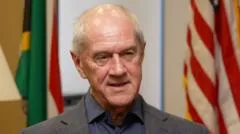
The notion of a South African white genocide does not exist, according to Roelf Meyer, the new South African ambassador to the United States. While Donald Trump has maintained that Afrikaners face systematic extermination, Meyer, a born Afrikaner and former apartheid-era mediator, asserts that crime statistics do not support such a designation. The dispute follows the Trump administration's launch of a refugee pathway for Afrikaners, which has already admitted nearly 13,000 refugees. This article examines the diplomatic tension, the reality of farm violence, and the legal controversy surrounding the US refugee programme.
Does the South African white genocide claim hold factual weight?
The claim that a genocide is being perpetrated against white Afrikaners in South Africa is not supported by current evidence or political consensus within the country. Roelf Meyer, the South African ambassador to the US, has explicitly challenged this narrative, stating that he has never experienced such a targeted phenomenon in his life. Meyer, who played a pivotal role in negotiating the end of apartheid in the 1990s, argues that the facts regarding violence in South Africa are being misrepresented to create a false narrative.
While farm violence is a documented issue in South Africa, it does not align with the legal or statistical definitions of genocide. According to police data, the vast majority of crime victims in South Africa, including those on agricultural properties, are black South Africans. While robberies and homicides on farms are serious concerns, experts suggest these incidents are largely criminal rather than part of a coordinated ethnic persecution.
The distinction between crime and persecution
The core of the disagreement lies in how violence is interpreted. Proponents of the genocide narrative, such as SJ Du Venage of the Freedom Front Plus, argue there is a political agenda intended to eliminate the white population. Conversely, many analysts point out that while rural safety is a significant challenge, the scale and motivation of these crimes do not meet the threshold of genocide. The high levels of crime in black townships actually represent a much larger proportional threat to South African citizens than farm-specific attacks.
How is the US refugee pathway affecting Afrikaner migration?
The Trump administration has established a specific refugee pathway for Afrikaners, a move driven by the President's assertion that the community is being systematically targeted. According to a notice sent to the US Congress, the administration plans to admit up to 17,500 additional white Afrikaners as refugees over the next 12 months. This follows an initial phase where nearly 13,000 refugees were admitted, the vast majority of whom were South African.
For some families, this programme represents a vital escape from perceived insecurity. Lielie, a refugee now living in Texas, described a constant state of fear on her family's macadamia and banana farm in South Africa, despite having electric fences and guard dogs. She noted that while her family was not physically harmed during incursions, they witnessed the brutal attacks of neighbors. Since moving to the US, she reports a significant increase in the sense of safety for her children.
What are the diplomatic consequences of the US-South Africa rift?
Diplomatic relations between Washington and Pretoria have soured significantly due to these conflicting views on racial policy and human rights. The Trump administration has recently implemented visa restrictions for South Africans accused of engaging in "race-based discrimination" against white citizens. Furthermore, the US has warned of additional punitive measures if South African leaders do not address the concerns raised by the White House.
Ambassador Meyer is tasked with mending these relations, leveraging his historical trust with President Cyril Ramaphosa. Meyer’s objective is to have the executive order underpinning the Afrikaner refugee pathway revoked. He argues that South Africa has not prevented emigration and is actively working to address crime. He has called for the US to provide resources and equipment to help South Africa combat crime more effectively, rather than imposing sanctions.
Why is the refugee programme being criticized by legal experts?
The US refugee programme faces criticism not only from the South African government but also from legal experts and some within the Afrikaner community itself. Larry Bartlett, the former director of the US Refugee Assistance Programme, has suggested that the programme might be unlawful. He argues that using resources intended for those fleeing genuine war or ethnic cleansing for individuals who are unlikely to qualify as refugees under international law could be a misuse of the system.
Some critics within South Africa question the logic of singling out one specific ethnic group for refugee status. Pastor Rudi Swanepoel from Johannesburg noted that South Africa faces massive challenges with gender-based violence, questioning why women are not given similar priority. Swanepoel suggests that much of the current Afrikaner grievance stems from a "loss of privilege" following the transition to democracy, rather than actual persecution. He uses the metaphor of a "cake" to explain that since the end of apartheid, the white minority must now share the resources and influence they once controlled exclusively.
What is the current status of land and racial policy in South Africa?
The tension between the US and South Africa is also fueled by South Africa's efforts to redress historic racial inequalities. The Trump administration has expressed concern over South African laws that allow for the expropriation of land without compensation in exceptional circumstances. These policies are aimed at correcting the imbalances left by the apartheid era, but they are viewed by the US as a threat to property rights and minority security.
Additionally, the US has raised concerns regarding South African targets for increasing non-white employment within companies. While the South African government maintains that these measures are legal and subject to judicial oversight—noting that the land expropriation law is currently awaiting a court judgment—the White House views them as part of a broader pattern of discrimination against white South Africans.
FAQ: South African White Genocide Claims
Is there a genocide against white South Africans?
No, there is no evidence of a genocide against white South Africans. While farm attacks and high crime rates are serious issues, South African officials, police data, and many Afrikaner leaders state that these are criminal matters rather than a coordinated attempt at ethnic extermination.
Why did the US create a refugee pathway for Afrikaners?
The Trump administration created the pathway based on President Trump's assertion that Afrikaners are being systematically targeted, raped, and killed. The administration views this as a humanitarian intervention to provide a lifeline to a community they believe is facing persecution.
How many Afrikaners have moved to the US under this scheme?
Nearly 13,000 refugees have been admitted to the United States through this programme so far. The US administration has indicated plans to admit an additional 17,500 Afrikaner refugees over the coming year.
What is the South African government's response to these claims?
The South African government has dismissed the genocide claims, noting that crime affects all racial groups and that the majority of crime victims are black. The government seeks to mend diplomatic ties and focuses on combating crime through domestic resources and international cooperation.
Does farm violence constitute persecution in South Africa?
While farm violence is a significant security concern, most experts and political leaders in South Africa do not classify it as persecution. They argue that these incidents are largely motivated by robbery and are part of a broader national crisis of violent crime.
Key takeaways
- Ambassador Roelf Meyer denies the existence of a white genocide in South Africa.
- The Trump administration plans to admit 17,500 more Afrikaner refugees.
- Police data indicates the majority of South African crime victims are black.
- Critics argue the US refugee programme may be misusing legal resources.
- Diplomatic tensions are rising over South African land and employment policies.
Conclusion
The debate over "white genocide" in South Africa represents a profound diplomatic and social divide. While the Trump administration views the Afrikaner community as victims of systemic persecution deserving of US protection, South African leadership and Ambassador Roelf Meyer maintain that the violence is a criminal issue rather than an ethnic one. As the US continues to expand its refugee programme, the friction between these two perspectives threatens to further complicate bilateral relations, especially as South Africa pursues legislative reforms to address the historical legacies of apartheid.