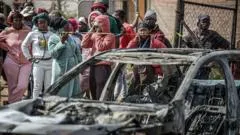
Two separate violent attacks near Johannesburg and Cape Town have left 27 people dead, underscoring a deepening crisis of gang-related gun violence and organized crime in the country. These brutal incidents have sent shockwaves through local communities, highlighting the extreme volatility of the current security landscape. As authorities struggle to contain the surge in lethal weaponry, the connection between these killings and illegal mining operations is becoming increasingly apparent. The sheer scale of the loss of life reflects a systemic failure to curb the influence of violent criminal syndicates operating across the nation's major urban hubs.
What are the details of the recent mass shootings?
Two distinct violent incidents resulted in a total of 27 fatalities across South Africa within a single 24-hour period. The first attack took place on a Saturday evening near Johannesburg, where eight gunmen targeted a bar, killing 17 people and leaving 15 others wounded. In this specific Johannesburg incident, the attackers opened fire on patrons outside the establishment before moving inside to continue the assault. They also set fire to two vehicles before escaping the scene.
The second incident occurred in the early hours of Sunday morning near Cape Town. Gunmen targeted an entertainment venue located in a township, resulting in 10 deaths and 11 injuries. According to reports, five victims died at the scene of the Cape Town shooting, while an additional five succumbed to their injuries in the hospital. As of Sunday morning, authorities had not confirmed any arrests in connection with either the Johannesburg or the Cape Town attacks.
These killings follow a recent pattern of extreme violence; just days prior, 11 people were killed in the city of Durban when gunmen stormed a house in the KwaMakhutha township. The rapid succession of these high-casualty events has intensified fears that the country's security landscape is becoming increasingly volatile.
What are the suspected motives behind the Johannesburg attack?
Police investigators are currently weighing several possible motives for the Johannesburg bar shooting, which claimed the lives of 13 men and four women. Gauteng Police Commissioner Lt Gen Tommy Mthombeni indicated that while the majority of the victims were South African nationals, individuals from Ethiopia and Lesotho were also among the deceased. The primary working theory involves robbery, as perpetrators reportedly stole personal belongings during the chaos.
However, law enforcement officials have not ruled out more complex criminal drivers, such as territorial disputes between illegal mining groups. This possibility is linked to the persistent issue of unauthorized mining in abandoned shafts and dump sites across the country. Such activities are often controlled by organized crime syndicates that recruit undocumented migrants to work in high-risk environments.
Adding to the complexity of the investigation, deputy provincial police commissioner Maj Gen Fred Kekana suggested that the attack may have been a retaliation for an incident that occurred last month, which resulted in one death and one injury. While police have stated they possess clear pictures and, in some instances, names of the suspects, no arrests had been made by Sunday morning.
The link between illegal mining and gang warfare
The intersection of illegal mining and organized crime creates a volatile environment in many South African regions. Authorities note that these mining operations are frequently managed by gangs involved in turf wars. These conflicts often escalate into high-intensity violence, including the use of illegal firearms, to secure control over lucrative, albeit unregulated, mining sites. This systemic issue contributes significantly to the unpredictability of violence in townships and mining peripheries.
Mining without permission in abandoned shafts or dump sites remains a persistent problem in South Africa, frequently resulting in numerous deaths due to unsafe conditions. Because these operations are often tied to organized crime, the violence used to protect these sites often spills over into civilian areas, as seen in the recent targeting of public venues like bars and entertainment centers.
How does this violence reflect the broader security crisis in South Africa?
South Africa continues to face one of the highest murder rates globally, with approximately 60 murders recorded every day in a population of 62 million. The recent wave of mass shootings follows a pattern of escalating violence, including the aforementioned incident in Durban. This sequence of events has heightened public fear that the country's security situation is deteriorating.
The prevalence of illegal weapons remains a critical factor in the country's inability to curb gun violence. Decades of systemic instability have allowed for the widespread circulation of unregistered firearms, which are frequently used in drug trafficking and gang-related territorial disputes. The frequency of these mass casualty events suggests that existing law enforcement measures are struggling to contain the reach of organized criminal networks.
The security situation is further complicated by localized crime waves. For instance, in Ekurhuleni, east of Johannesburg, a tenth woman's body was discovered on Saturday. Local police stated they are unable to rule out the possibility of a serial killer operating in the area, given the similarities between the deaths.
What actions are authorities taking to combat organized crime?
The South African government has recognized organized crime as a fundamental threat to national stability. In February, President Cyril Ramaphosa identified organized crime as "the most immediate threat to our democracy, our society and our economic development."
In response to the rising tide of armed violence, the government has attempted to increase the presence of security forces in high-risk areas. Earlier this year, the military was deployed to work alongside police forces in regions identified as having the highest murder rates. This strategy aims to provide additional support to law enforcement in curbing the influence of gangs and reducing the frequency of armed confrontations.
Despite these measures, the recent spate of killings demonstrates the ongoing difficulty in dismantling the deeply entrenched structures of organized crime. The transition from localized crime to mass casualty events involving multiple gunmen suggests that the criminal elements continue to operate with a high degree of coordination and firepower.
FAQ: Mass shootings in South Africa
How many people died in the recent shootings?
A total of 27 people were killed across two separate mass shootings. Seventeen people died in an attack on a bar near Johannesburg, and 10 people were killed in a shooting outside an entertainment venue near Cape Town.
What is the suspected motive for the Johannesburg attack?
Police believe the motive for the Johannesburg shooting may be robbery, as personal belongings were taken. However, investigators are also looking into the possibility of turf wars between illegal mining groups and potential retaliation for a previous incident as causes for the violence.
Who were the victims in the Johannesburg incident?
The victims in the Johannesburg attack included 13 men and four women. While most were South African nationals, Gauteng Police Commissioner Lt Gen Tommy Mthombeni confirmed that people from Ethiopia and Lesotho were also among the deceased.
Is there a connection to illegal mining?
Authorities suggest a potential link between recent violence and illegal mining groups. Gangs often engage in turf wars to control unauthorized mining in abandoned shafts, a practice frequently carried out by organized crime syndicates using undocumented migrants.
Has anyone been arrested for these crimes?
As of Sunday morning, following the two mass shootings, police had not made any arrests in either the Johannesburg or the Cape Town cases.
Key takeaways
- Twenty-seven people were killed in two separate mass shootings near Johannesburg and Cape Town.
- The Johannesburg attack involved eight gunmen and resulted in 17 deaths and 15 injuries.
- Police are investigating robbery, illegal mining turf wars, and potential retaliation as motives.
- South Africa experiences approximately 60 murders daily within its population of 62 million.
- The military has been deployed alongside police to combat high murder rates in specific regions.
Conclusion
The recent mass shootings in Johannesburg and Cape Town serve as a grim reminder of the persistent security challenges facing South Africa. With 27 lives lost in a matter of hours, the scale of these attacks highlights the lethal impact of gang-related violence and the proliferation of illegal firearms. While authorities are exploring motives ranging from robbery to mining turf wars, the broader context of organized crime continues to threaten the nation's social and economic stability. The deployment of military support marks a significant attempt to address the crisis, yet the frequency of these mass casualty events suggests a complex and deeply rooted struggle for control.