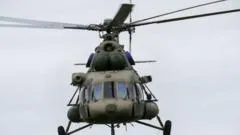
A brief but significant incursion by a Russian Mi-8 helicopter near the Kaliningrad border has intensified fears regarding Russia's use of hybrid warfare to test NATO's eastern flank. This sudden breach of sovereignty forced immediate defensive responses from regional air command centers. As tensions rise along the Suwalki Gap, military analysts suggest such maneuvers are designed to probe reaction times and identify vulnerabilities in the alliance's integrated air defense systems. The incident highlights the growing volatility of the Baltic region.
What are the specific details of the airspace incursion?
A Russian Mi-8 military helicopter penetrated Polish airspace for 42 seconds on Wednesday morning, marking a significant breach of sovereign territory near the Kaliningrad border. The aircraft entered Polish airspace from the Russian exclave, reaching a depth of approximately 300 metres (328 yards) north of the Braniewo region. The Polish Army Operational Command confirmed that the movement was detected by radar systems at 11:08 local time.
The Polish military responded immediately to the detection by scrambling fighter jets to intercept or monitor the intruder. While the flight duration was brief, the Polish military stated that the nature of the incident suggests a deliberate attempt by Russia to test the readiness of Polish and NATO air defence systems. Ground forces were also placed on alert to ensure a rapid response to any further escalations.
Radar detection and military response
The precision of the radar tracking allowed Polish air defence units to monitor the Mi-8's flight path throughout its 42-second presence. This rapid detection is a core component of the "around the clock" operations currently being maintained by Poland to ensure the safety of its airspace. The incident highlights the ongoing necessity for high-readiness protocols along the borders of NATO members sharing a frontier with Russia or its exclaves, particularly in the sensitive corridor near Kaliningrad.
How does this incident fit into the pattern of Russian hybrid warfare?
The airspace violation is viewed by Polish officials as part of an intensifying campaign of hybrid warfare designed to destabilise European security. Hybrid warfare involves non-military methods—such as cyberattacks, sabotage, and misinformation—intended to exert pressure on adversaries without triggering a full-scale conventional conflict. Polish Prime Minister Donald Tusk has explicitly warned that these threats are intended to intimidate European nations and undermine the collective effort to support Ukraine.
Tusk noted that in recent weeks, the Russian hybrid threat against Europeans has intensified, with the intent to break the effort to support Ukraine. However, he emphasized that the result would be the exact opposite, as security in Ukraine is seen as directly linked to the security of the European continent. This sentiment is echoed by the observation that the intent is to intimidate, yet the resolve of NATO members remains a primary target of these provocations.
Recent months have seen a surge in suspicious activities across the European continent that align with these hybrid tactics. These include:
- Unexplained fires and explosions at defence facilities in countries including Italy, Bulgaria, and Estonia, with some nations blaming Russia.
- A drone attack at Leipzig airport in Germany, which German authorities linked to Russia earlier this month.
- The landing of Russian drones and one unarmed Russian missile within Polish territory since the start of the 2022 invasion of Ukraine.
While Moscow consistently denies involvement in these incidents, characterizing accusations as "absurd," many European leaders view these actions as a coordinated strategy to test the resolve of the NATO alliance and its commitment to its members.
What is the strategic impact on NATO's eastern flank?
The repeated incursions and hybrid activities are placing significant pressure on the security infrastructure of NATO's eastern flank. Nations such as Poland and Lithuania are actively preparing for potential escalations. For instance, the Lithuanian Prime Minister recently told the BBC that his country has already developed evacuation plans in response to threats from Russia, though he emphasized a policy of "not surrender" if attacked.
The psychological dimension of these provocations is a key element of the strategy. By creating a sense of instability, the goal is to break the political will of NATO members to provide military and financial assistance to Ukraine. However, Polish leadership has countered this narrative, stating that such intimidation efforts do not work because the security of the region is fundamentally at stake in the ongoing conflict in Ukraine.
The role of critical infrastructure protection
In response to the rising tide of hybrid threats, European leaders are moving beyond military readiness to focus on civilian and industrial security. French President Emmanuel Macron has noted that France has been targeted by similar hybrid attacks in recent weeks. Consequently, he has ordered comprehensive plans to protect France's critical infrastructure and its defence industry sites from sabotage or cyber interference, vowing that such attacks will not be left "without a response."
How has Russia responded to these accusations?
Moscow has largely maintained a stance of denial regarding the airspace violation and other alleged hybrid operations. While there was no immediate comment following the specific Mi-8 incident in Poland, Russian officials have historically dismissed such claims. Russian President Vladimir Putin has repeatedly stated that Moscow has no intention of attacking NATO member states.
However, the rhetoric from the Kremlin remains highly aggressive. Russian Foreign Minister Sergei Lavrov has shifted the blame toward Europe, claiming that European nations are the ones constantly talking about preparing for war. Lavrov issued a stark warning, suggesting that if Europe were to attack Russia, the resulting conflict would be fundamentally different from the war in Ukraine and would be "very short."
This tension is compounded by the ongoing war in Ukraine, where Russia currently controls roughly 20% of Ukrainian territory, including the Crimea peninsula annexed in 2014. The proximity of the conflict to NATO borders ensures that any military movement or airspace breach is treated with the highest level of strategic concern. This is further illustrated by recent incidents in Ukraine, such as a Russian drone striking a passenger train near the Polish border on 13 September, an event that occurred shortly after high-level European security officials and former UK Prime Minister Boris Johnson had passed through on the same line.
FAQ: Russian military helicopter airspace violation
What caused the Polish military to scramble fighter jets?
The Polish military scrambled fighter jets because a Russian Mi-8 military helicopter violated Polish airspace for 42 seconds. The aircraft, originating from the Kaliningrad exclave, was tracked by radar near Braniewo, necessitating an immediate response to ensure the integrity of Polish airspace and test air defence readiness.
What is considered hybrid warfare in the European context?
Hybrid warfare refers to non-military tactics used to destabilise an adversary, such as cyberattacks, sabotage, and misinformation. In Europe, this includes suspicious fires at defence sites, drone incursions, and psychological intimidation intended to weaken the support provided to Ukraine and test NATO's commitment to its members.
Has Russia admitted to the airspace incursion?
Russia has not provided an immediate comment or admission regarding the specific Mi-8 helicopter incursion in Poland. Historically, Moscow has denied responsibility for airspace violations and other hybrid attacks, often describing such accusations from European governments as unfounded or absurd.
How are NATO members responding to these threats?
NATO members are responding through increased military readiness, such as Poland's around-the-clock air defence, and by strengthening critical infrastructure protection. Some nations, like Lithuania, have even developed evacuation plans, while others, like France, are implementing specific plans to safeguard their defence industries and essential services.
What is the significance of the Kaliningrad exclave in these incidents?
Kaliningrad is a Russian exclave situated between Poland and Lithuania, making it a high-tension zone. Its proximity to NATO borders means that military activities, such as helicopter flights or drone movements, can quickly lead to airspace violations and heightened military alerts along the eastern flank.
Key takeaways
- A Russian Mi-8 helicopter violated Polish airspace for 42 seconds near Braniewo.
- The incursion originated from the Russian Kaliningrad exclave and was detected by radar.
- Poland interpreted the event as a test of its air defence readiness.
- European leaders are increasingly citing hybrid warfare, including sabotage and cyberattacks, as a major threat.
The evolving security landscape in Eastern Europe
The recent airspace violation in Poland serves as a stark reminder of the volatility defining the relationship between Russia and NATO. As hybrid threats move from the digital realm into physical territory through sabotage and airspace incursions, the distinction between peace and conflict becomes increasingly blurred. For NATO's eastern flank, the challenge lies in maintaining a robust defence posture that can respond to both conventional military movements and the subtle, destabilising tactics of hybrid warfare. The ability of the alliance to maintain unity and protect critical infrastructure will be the decisive factor in managing this escalating tension.