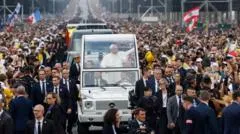
Hundreds of thousands of faithful have gathered in the heart of the French capital to witness a historic moment. As Pope Leo XIV leads a massive open-air mass, the pontiff uses this sacred platform to address pressing global humanitarian concerns and the complex ethics surrounding artificial intelligence. Beyond these modern dilemmas, the ceremony serves as a deeply personal homecoming, allowing the Pope to reflect on his own ancestral ties to France. This spiritual assembly marks a significant milestone in his current four-day diplomatic and religious tour of the nation.
How large is the crowd for the Pope's Mass in Paris?
Hundreds of thousands of people have gathered in the heart of Paris to greet Pope Leo XIV for a monumental open-air Mass. The scale of the event is significant, with expectations that more than half a million attendees will occupy the space around the Place de la Concorde, where a special altar has been constructed specifically for the ceremony.
The atmosphere in the city is characterized by high energy and religious fervor. As the pontiff moved through the streets, crowds cheered and chanted "Leo, Leo" in a rhythmic display of devotion. The procession took place along the iconic Champs-Élysées Avenue, passing beneath the historic Arc de Triomphe. As the Pope moved through the crowds in his popemobile, he engaged directly with the public, including stopping at different stages along the avenue to bless several infants.
This massive turnout is interpreted by the Catholic Church as a significant indicator of contemporary religious life. Church officials believe the scale of the gathering reflects a growing spirituality not only among the French population but across the broader European continent. The presence of such vast numbers in a major secular capital underscores the continued cultural and spiritual weight of the papacy in the region.
The scale of religious engagement in France
The enthusiasm for the papal visit is not confined to the streets of Paris. The mobilization of the faithful is visible across various regions of France, suggesting a widespread interest in the pontiff's message. For example, the engagement extends to the Pyrenean sanctuary of Lourdes, where 150,000 people have already signed up to attend a Mass on Sunday. This high level of registration demonstrates a significant religious mobilization during this four-day tour, spanning from the urban center of the capital to the historic pilgrimage sites of the south.
Who is attending the papal events in France?
The attendance at the Pope's Mass reflects a complex intersection of religious devotion and the intricacies of French political life. While French President Emmanuel Macron met with the Pope for an hour of private talks on Friday, he will not attend any of the Masses during this four-day visit. This decision is a strategic necessity to avoid breaching France's strict principle of the separation of state and religion, a cornerstone of the French Republic's secular identity.
However, the absence of the Head of State does not mean the event lacks high-level political representation. The presence of other senior officials underscores the importance of the Pope's visit to the nation. Brigitte Macron, the President's wife, and Prime Minister Sébastien Lecornu are both expected to attend the ceremonies, ensuring a level of state recognition that respects legal boundaries.
Political figures present at Place de la Concorde
The event serves as a significant gathering point for several prominent figures in French politics, many of whom are currently navigating the landscape of next year's presidential election. The diversity of the political attendees highlights the cultural impact of the Pope's visit. Several key political actors were identified at the Place de la Concorde ahead of the ceremony, including:
- Marine Le Pen: The leader of the hard-right National Rally party.
- Bruno Retailleau: A prominent conservative figure.
- Edouard Philippe: The Mayor of Le Havre and former Prime Minister.
- Gabriel Attal: A centrist politician.
- Francois Fillon: A former Prime Minister.
The presence of such a wide spectrum of leaders—ranging from the hard-right to the center—demonstrates that the papal visit transcends partisan divides, even as the political class uses the occasion to maintain visibility.
What messages did Pope Leo XIV deliver during his visit?
Pope Leo XIV has utilized his platform in France to address both urgent humanitarian concerns and the complex ethical challenges posed by modern technology. During his visit to the Maison Bakhita centre, an association dedicated to supporting refugees, the Pope met with migrants and offered praise for the organization's mission. He noted that the center had invited "us to see those who are invisible," highlighting the importance of recognizing the dignity of displaced persons.
In his remarks to the migrants, the Pope emphasized the necessity of social cohesion and mutual respect. He stated that it is "possible to encounter one another and to live together in dignity and peace." This message of coexistence was paired with a focus on the role of women in society. He stressed the "fundamental role of women in building a civilisation of love," positioning gender and social inclusion as central themes of his theological and social message during the tour.
Warnings regarding artificial intelligence
Beyond humanitarian issues, a significant portion of the Pope's visit was dedicated to the ethical implications of rapid technological advancement. During his meetings with Church and state officials at the Élysée Palace on Friday, he issued a stern warning regarding the rise of artificial intelligence. He cautioned leaders against the risk of "losing our humanity amid a paradise of machines." This warning suggests that the unchecked integration of AI could potentially threaten the core essence of human existence and the quality of social interactions, a concern he brought directly to the highest levels of the French state.
What is the background of Pope Leo XIV?
Pope Leo XIV brings a unique personal history to his role, characterized by deep ancestral ties to France despite his American upbringing. Born in Chicago in 1955, he was originally known as Robert Prevost. His connection to the French nation is rooted in his paternal lineage; his grandmother was born in Le Havre, Normandy, in 1894.
The history of his name is also tied to this heritage. When his grandmother married in the United States many years later, she and her Italian husband adopted the name Prevost, which was her mother's maiden name. This lineage provides a personal dimension to his visit, as he returns to the land of his ancestors.
The Pope's itinerary continues with a visit to Metz in northeast France on Monday. During this stop, he is scheduled to pay tribute to Robert Schuman (1886-1963). Schuman, a founding father of the European Union and a fervent Catholic, is currently a candidate for beatification. By honoring Schuman, the Pope intends to highlight the historical links between religious faith and the foundational political structures of modern Europe.
FAQ: Pope Leo XIV Paris visit
How many people are expected at the Paris Mass?
More than half a million people are expected to attend the open-air Mass held at the Place de la Concorde. The event follows massive crowds that have already lined the Champs-Élysées.
Why is President Emmanuel Macron not attending the Masses?
President Macron is avoiding the Masses to respect France's strict separation of church and state. While he met the Pope for private talks at the Élysée Palace, his absence from the religious ceremonies preserves secularist principles.
What did the Pope say about artificial intelligence?
The Pope warned against the dangers of AI, cautioning that humanity must not lose its essence within a "paradise of machines." He delivered these remarks to Church and state officials at the Élysée Palace.
Who are the political figures attending the event?
Attendees include Prime Minister Sébastien Lecornu, Brigitte Macron, Marine Le Pen, Bruno Retailleau, Edouard Philippe, Gabriel Attal, and Francois Fillon.
What is the Pope's connection to France?
Born Robert Prevost in Chicago, the Pope has French roots through his paternal grandmother, who was born in Le Havre, Normandy, in 1894.
Key takeaways
- Over 500,000 people are expected to attend the Mass at Place de la Concorde.
- President Macron will not attend Masses to respect French secularism.
- The Pope warned that AI could lead to losing human essence.
- 150,000 people have signed up for the Mass in Lourdes.
- The Pope will honor EU founder Robert Schuman in Metz.
Conclusion
The visit of Pope Leo XIV to France represents a significant moment of both religious and cultural convergence. By drawing hundreds of thousands to the streets of Paris, the pontiff has demonstrated the enduring influence of the Catholic Church in Europe. His messages—ranging from the protection of migrant dignity to the ethical regulation of artificial intelligence—seek to address the most pressing anxieties of the modern age. As the tour moves toward Lourdes and Metz, the intersection of faith, politics, and European identity remains the defining characteristic of this historic pilgrimage.