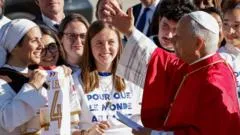
As Pope Leo XIV begins a high-profile four-day tour of France, he issues a profound warning against the dehumanizing potential of artificial intelligence and navigates the complexities of French secularism. The Pontiff emphasizes that technological progress must never supersede the inherent sanctity of the human soul. During his discussions with local leaders, he calls for a global ethical framework to govern machine learning. This visit serves as a critical moment for the Church to engage with modern secular societies while defending traditional moral values in an increasingly digital age.
Why is Pope Leo XIV warning against the rise of artificial intelligence?
Pope Leo XIV has issued a stern warning regarding the potential for humanity to be overshadowed by rapid technological advancement. During his discussions with President Emmanuel Macron at the Élysée Palace, the pontiff expressed a deep-seated concern about the risk of "losing our humanity amid a paradise of machines." This statement serves as a continuation of his ongoing theological and ethical engagement with emerging technologies, positioning the Church as a moral watchdog in the digital age.
The Pope's stance on AI is not a new development but a central pillar of his papacy's teaching. In May of this year, he released his first major teaching document, in which he advocated for the necessity of "disarming" artificial intelligence. This call for restraint is rooted in a desire to ensure that technology serves human ends rather than dictating human value. He has drawn provocative and sobering parallels between the current trajectory of AI development and the history of the slave trade, suggesting that the world is in danger of normalizing the exploitation of people once again through automated or systemic means.
By framing the AI debate within the context of historical injustices like the slave trade, Leo XIV highlights a fear that technological efficiency might eventually justify the devaluation of human labor and the dignity of the individual. This perspective seeks to place a moral check on a sector that often moves faster than legislative or ethical frameworks can accommodate, warning that a "paradise of machines" could become a landscape of human marginalization if not properly disarmed.
The ethical dimension of AI in papal teaching
The Vatican's concern rests on the idea that AI must be governed by human-centric ethics to prevent the erosion of personhood. By comparing the potential misuse of AI to historical injustices, the Pope suggests that the automation of decision-making and labor could lead to a new era of exploitation. This warning serves as a call to global leaders to ensure that progress does not come at the expense of the most vulnerable, ensuring that technological advancement remains a tool for human flourishing rather than a mechanism for dehumanization.
How does the visit navigate the complexities of French secularism?
The Pope Leo XIV visit to France must carefully balance religious presence with the nation's strict adherence to laïcité, or secularism. While President Macron welcomed the visit as a "great honour," he will not attend any of the Pope's Masses to uphold the legal separation of church and state. This distinction is crucial in a political landscape where secularism is frequently used to regulate religious expression in public spaces, including bans on religious symbols such as Muslim women's attire in schools and public areas.
Pope Leo XIV has addressed this tension directly, arguing that "authentic secularity" should not result in the exclusion of religion from education or the public sphere. His remarks suggest a desire for a more inclusive public square where faith can coexist with state neutrality. Macron has attempted to bridge this gap by stating that French secularism "in no way negates religion," a sentiment echoed by the presence of the Prime Minister, Sébastien Lecornu, and the President's wife, Brigitte Macron, at the upcoming Paris Mass.
Despite the high-level diplomatic respect, the visit has not been without friction. Reports surfaced of tensions between the Macron administration and the Vatican team regarding the ceremonial nature of the trip. While the Élysée suggested it was customary to offer the Pope high-profile honors—such as a cavalry escort down the Champs-Élysées—they noted it was never expected he would accept. Furthermore, the Pope declined an invitation to meet with the artisans who rebuilt the fire-devastated Notre-Dame cathedral, citing an excessively tight schedule.
What is the planned itinerary for the four-day visit?
The Pope's schedule is densely packed with high-profile religious and social engagements across several French cities, designed to reach a wide demographic spectrum from youth to the elderly. Following his arrival at Orly airport and a meeting in Paris, the pontiff will participate in a massive gathering at the Stade de France in northern Paris, where approximately 80,000 young people are expected to join him for an evening event.
The visit is structured to maximize both spiritual impact and social outreach:
- Friday: Diplomatic meetings at the Élysée Palace, a popemobile procession through the crowds toward Notre Dame, and an evening rally with 80,000 young people at the Stade de France.
- Saturday: A massive Mass at the Place de la Concorde in Paris, with an altar constructed specifically for the event. This gathering is expected to draw more than half a million people.
- Sunday: A pilgrimage to the sanctuary of Lourdes, where 150,000 people have already signed up to attend Mass. During this stop, the Pope will also meet with victims of sexual abuse by members of the Catholic clergy.
- Monday: A visit to Metz in northeast France to pay tribute to Robert Schuman (1886-1963), a founding father of the European Union and a devout Catholic currently a candidate for beatification.
Beyond these formal liturgies, the Pope's itinerary includes significant social engagements, such as meeting with migrants in Paris. These meetings underscore the Vatican's intention to address contemporary social crises and the lived experiences of the marginalized alongside traditional spiritual duties.
What are the historical and demographic trends of Catholicism in France?
The relationship between the Papacy and France is historically layered and often fraught. While France was long referred to as the "Eldest Daughter of the Church," this title is historically inaccurate, as Armenia, Georgia, and Ethiopia preceded it in Christian conversion. The history is further complicated by the 14th-century Avignon Papacy and centuries of French military intervention in Italian politics, during which popes served as both secular and religious rulers. Even Napoleon once held popes in captivity.
In the modern era, France has undergone a profound religious transformation. The country has secularized alongside the rest of Europe, and currently, less than half of the population identifies as Catholic. The demographic shift is stark:
- Regular worshippers: Dropped from 35% of the population in 1960 to less than 5% today.
- Clergy numbers: The number of priests has shrunk by two-thirds, from 25,000 in 1990 to fewer than 9,000.
However, recent data suggests a nuanced picture of religious life. While traditional participation has declined, there are signs of a growing interest in religious tradition and roots. For instance, adult baptisms have more than doubled in a five-year period, reaching 10,000 in 2025. Cardinal François Bustillo, Bishop of Ajaccio, has characterized this as a response to a "void where God and values used to be," suggesting that as people search for meaning, they are looking back toward their spiritual heritage. As the Cardinal noted, if John-Paul II awoke the East, Leo XIV may be the figure to "awake the West."
FAQ: Pope Leo XIV visit to France
What is the main theme of Pope Leo XIV's visit?
The primary themes are the ethical challenges posed by artificial intelligence and the role of faith in a secularized society. The Pope aims to address the potential loss of human dignity in an automated world and engage with the evolving spiritual landscape of Europe.
Why is President Macron not attending the Masses?
President Macron is adhering to the French principle of laïcité, which mandates the strict separation of church and state. To maintain this constitutional norm, he will engage in diplomatic meetings but will not participate in religious services.
How many people are expected to attend the Paris Mass?
The Mass at the Place de la Concorde is a massive undertaking, with organizers expecting more than 500,000 attendees to gather around the Champs-Élysées area.
Who is Robert Schuman and why is the Pope visiting Metz?
Robert Schuman was a founding father of the European Union and a fervent Catholic. Pope Leo XIV is visiting Metz to pay tribute to Schuman's legacy and his current status as a candidate for beatification.
Has the Catholic population in France increased recently?
While regular worshipers have decreased significantly since 1960, there is a growing trend in other areas. Adult baptisms have more than doubled in five years to hit 10,000 in 2025, indicating a renewed search for spiritual roots.
Key takeaways
- Pope Leo XIV warns that AI development risks "losing our humanity" and could normalize human exploitation.
- A massive Mass in Paris is expected to draw over 500,000 people.
- The visit navigates the tension between religious presence and French secularism (laïcité).
- Despite declining regular worship, adult baptisms in France have doubled to 10,000 in 2025.
- The Pope will honor EU founder Robert Schuman in Metz.
Conclusion
The visit of Pope Leo XIV to France serves as both a spiritual pilgrimage and a profound diplomatic engagement. By addressing the existential risks of artificial intelligence, the Pope seeks to reassert human dignity in an increasingly automated era. Simultaneously, his presence in France navigates the delicate balance between religious tradition and the nation's secular identity. While the demographic data shows a traditionally Catholic nation that has largely secularized, the massive expected crowds and rising baptism rates suggest that the search for spiritual meaning remains a potent force in the West.