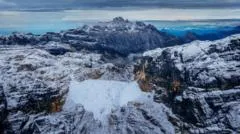
As the last remnants of tropical ice vanish from the Sudirman Range, the region faces a dual crisis of scientific loss and spiritual devastation for its Indigenous peoples. This rapid melting threatens to erase a unique geological record that has existed for millennia. Beyond the environmental impact, the disappearance of these glaciers strikes at the heart of local cultural identity. For the communities living in the shadow of these peaks, the ice is not just frozen water, but a sacred presence that defines their ancestral connection to the land and their spiritual heritage.
Why are the Papua glaciers disappearing so rapidly?
The retreat of the glaciers in the Sudirman Range is driven by rising global temperatures caused by human activities, specifically the combustion of fossil fuels such as oil, gas, and coal. Because these mountains are located only 450km south of the equator, the window for ice survival is extremely narrow. As the atmosphere warms, the freezing point shifts to higher altitudes, causing precipitation that once fell as snow to arrive as rain instead.
Local environmental factors also play a significant role in the acceleration of this melt. While global warming provides the primary thermal pressure, the specific pace of disappearance is influenced by several variables that dictate whether a glacier can survive at all in such a delicate climatic range:
- Variations in local cloud cover.
- Fluctuations in annual snowfall amounts.
- Specific mountain topography.
- The occurrence of El Niño events, which can intensify warming patterns.
According to researcher Klaus Thymann, the scale of the loss is staggering; between the early 2000s and 2025, the glaciated area in the region receded by approximately 95%. This leaves only small, isolated patches of ice remaining around the Carstensz Pyramid, also known as Puncak Jaya. These remaining areas are expected to disappear entirely within a year or two.
What is the scientific importance of these tropical ice cores?
The remaining ice in Papua serves as a unique, isolated archive of Earth's climatic history. Unlike other glacier systems, the tropical glaciers in Papua are separated from the Andes and the Himalayas by thousands of kilometres, making them a distinct and vital subject of study for glaciologists. These ice cores preserve vital data regarding historical atmospheric conditions in a region that is otherwise difficult to access.
By analyzing these cores, scientists can gain insights into the evolution of the planet's warmest ocean waters. Specifically, the ice provides a record of the tropical Pacific and the Western Pacific Warm pool. This data is essential for understanding how changes in ocean temperatures influence global weather patterns and climate stability. The archive offers a window into the relationship between mountain ice and the surrounding oceanic environments.
The race against time for glaciologists
There is a growing sense of urgency among the scientific community because this archive is being destroyed before it can be fully documented. Czech glacier ecologist Marie Šabacká, who visited Puncak Jaya in March, noted that the disappearance of these glaciers removes a critical biological habitat and a unique window into the past. She traveled to the region in a bid to be among the last scientists to study the "eternal snow" before it is lost.
As the ice vanishes, the ability to reconstruct the climatic shifts of the tropical Pacific diminishes, leaving a permanent gap in our understanding of regional environmental history. The loss is not just a change in scenery; it is the erasure of a natural record that has been accumulating for centuries.
How does the melting ice affect Indigenous spiritual life?
For the Indigenous peoples of Papua, the disappearance of the ice is not merely an environmental metric but a profound spiritual crisis. At least five distinct groups maintain deep ancestral ties to the peaks of the Sudirman Range. For instance, the Moni people refer to the mountain as Mbaingela, believing it to be a place where their ancestors reside and watch over the living.
The Amungme people hold an even more central connection to the range, calling it Nemangkawi, or the "White Arrow." This symbol is deeply embedded in their moral and social fabric. According to Elfrida Natkime, a young Amungme woman, the White Arrow represents honesty, purity, and moral integrity. Traditionally, parents and grandparents would pray that their children would possess hearts as pure as the mountain's snow, using the peak as a compass for proper living.
The loss of this landscape is described by activists as a destruction of their cultural foundation. Adolfina Kum, an Amungme environmental activist, compares the loss of the sacred peaks to the destruction of Mecca for Muslims or the Vatican for Catholics. She suggests that when these ancestral places are disturbed, the community loses its essential source of strength, much like a tree losing its roots. Once the foundation is removed, the cultural identity of the people risks being shattered.
What is the link between industrial development and environmental change?
The transformation of the Papuan landscape is closely tied to the discovery and extraction of vast mineral deposits, including copper and gold. Throughout the 20th century, industrial projects have significantly reshaped the region, with the Grasberg mine—one of the world's largest copper and gold operations—playing a central role. This industrial presence has brought a complex mix of economic shifts and environmental degradation.
The impact of these extractive industries is viewed through two distinct lenses by local residents:
- Economic Opportunities: Development has introduced jobs, improved roads, provided education, and created new livelihoods for many in the region.
- Environmental and Social Costs: The expansion of mining has led to the excavation of entire mountain faces, the loss of access to ancestral lands, and decades of social conflict.
Elfrida Natkime observes this duality, noting that while the development has provided livelihoods, the visible exploitation of the mountains causes significant sadness. This industrial reshaping of the valleys and mountains—including the construction of roads and settlements—occurs alongside the climatic melting of the peaks, creating a multi-layered crisis for the traditional inhabitants of the region.
Frequently asked questions
How much ice has been lost in Papua?
The loss has been extreme. In the 19th century, glacier cover in the region spanned nearly 1,900 hectares. Today, only about 16 hectares remain around Puncak Jaya. This represents a reduction of approximately 99% of the historical ice cover.
Why are Papua's glaciers unique?
Papua's glaciers are unique because they are isolated tropical ice systems located thousands of kilometres away from other major glacier systems like the Andes or the Himalayas. This makes them a distinct and vital subject for studying tropical climate history.
What does the "White Arrow" represent?
For the Amungme people, the "White Arrow" (Nemangkawi) is a symbol of moral integrity, honesty, and purity. It serves as a spiritual guide, representing the path of righteousness that ancestors and elders hope their descendants will follow.
Can El Niño affect these glaciers?
Yes, El Niño events can accelerate the melting process. While global warming is the primary driver, El Niño contributes to the climatic shifts that increase temperatures and alter precipitation patterns, pushing the freezing point higher up the mountains.
Is the ice disappearance permanent?
The current retreat is considered permanent within a human lifetime. Scientists expect the remaining small areas of snow around Puncak Jaya to disappear entirely within the next one to two years due to rising temperatures.
Key takeaways
- Papua's glacier cover has shrunk from 1,900 hectares to just 16 hectares.
- The remaining tropical ice is expected to vanish within one to two years.
- The melting ice destroys a unique scientific archive of the Western Pacific Warm pool.
- Indigenous groups like the Amungme view the ice as a vital spiritual anchor.
- Industrial mining has simultaneously provided livelihoods and caused environmental degradation.
Conclusion
The imminent disappearance of the Papua glaciers marks the end of a centuries-old climatic and cultural era. As the last remnants of tropical ice vanish from the Sudirman Range, the world loses a critical scientific record of the Pacific's environmental history. Simultaneously, the Indigenous communities of Papua face the erosion of their spiritual foundations and ancestral identities. The convergence of global climate change and local industrial development has created a landscape in transition, where the loss of "eternal snow" signifies a profound shift for both the planet and the people who call these mountains home.