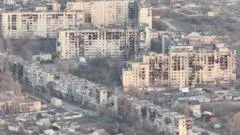
Trapped by Russian forces and lacking food, water, and electricity, the residents of Oleshky face a desperate struggle for survival amidst ongoing shelling and strict burial restrictions. The blockade has severed essential supply lines, leaving families to endure extreme deprivation without any reliable access to basic necessities. As the occupation intensifies, the humanitarian situation deteriorates rapidly, leaving civilians caught in a lethal crossfire. Local reports indicate that the lack of medical supplies is making even minor injuries life-threatening for the aging population.
How has the blockade impacted food and water security in Oleshky?
The local population is currently living under what Ukrainian Foreign Minister Andriy Sybiha describes as a "full blockade" imposed by Russian forces. This blockade has resulted in a near-total absence of commercial food supplies, with some residents reporting that the last official food delivery to the city occurred in May. The lack of resources has forced civilians to adopt extreme survival measures to avoid starvation.
Residents have reported that they are reduced to eating once a day, often consisting of minimal portions of bread, honey, or vegetables. As summer vegetable stocks have been exhausted, many inhabitants have turned to foraging for garden weeds. Local Telegram messaging groups have become essential tools for survival, with residents using them to discuss which weeds are safe to consume and how to boil them, as well as coordinating the swapping or selling of meager food supplies. The desperation is palpable; for many, the daily struggle is not just about finding food, but finding food that is safe to eat.
The loss of basic utilities and infrastructure
The humanitarian situation is exacerbated by the total collapse of municipal infrastructure. Since the attack on the Kakhovka dam three years ago, Oleshky has been without reliable access to electricity, gas, or running water. The destruction of the dam, which Ukraine and NATO attribute to Russian actions while Russia blames Ukraine, left many buildings flooded up to their rooftops and permanently disrupted the city's ability to sustain its population. Without water or gas, even basic cooking and hygiene have become nearly impossible, contributing to the overall degradation of living standards. The city, which was home to 24,000 people before the full-scale invasion, is now a shadow of its former self, struggling to maintain the most fundamental aspects of human dignity.
What is the current scale of civilian casualties in the region?
Documenting the exact number of fatalities in Oleshky is extremely difficult due to restricted access and the nature of the conflict. While the UN Human Rights Monitoring Mission in Ukraine has recorded at least 29 civilian deaths and 54 injuries in Oleshky and nearby Hola Prystan this year, local volunteers suggest the actual figures are significantly higher. One volunteer, Ksenia Arkhipova, has been maintaining a personal registry of the deceased, which has grown to approximately 1,200 names since mid-2022.
Deaths are frequently caused by drone strikes, landmines, or direct gunfire during house searches by occupation forces. For example, a husband and wife were recently killed by a drone while attempting to transport food from the neighboring town of Radensk, 23km away, because they were unable to return home before a curfew imposed by Russian authorities. The city's geography, trapped between the Dnipro River and Russian-controlled territory, creates a high-risk environment for anyone attempting to move through the area to secure supplies. For many, the attempt to find food or medicine results in a fatal encounter with a drone or a landmine.
The difficulty of verifying death tolls
The inability to conduct independent investigations means that many deaths likely go unrecorded. Local volunteers note that the list of deceased grows daily, with casualties resulting from both active combat and the hazards of navigating mined roads. Because many residents live in fear of identification, they often provide pseudonyms when reporting deaths, making it difficult for international observers to establish a definitive statistical baseline for the mortality rate in the occupied zone. This lack of verification leaves the true human cost of the occupation in Oleshky shrouded in uncertainty.
Why are burial restrictions being used as a tactic?
Russian occupation authorities have reportedly imposed strict restrictions on how and when residents can bury the dead, a move described by humanitarian workers as a form of psychological pressure. According to local accounts, burials are prohibited for individuals killed by drones, landmines, or other combat-related incidents unless a post-mortem examination is performed by a Russian doctor. Given the lack of medical infrastructure in the city, such examinations are virtually impossible to obtain.
Consequently, only those who die of natural causes are permitted to be buried. This policy has led to harrowing scenes where bodies remain in the streets or are left in hospital morgues that lack electricity. Ester Vrataryova, co-founder of the charity Humanity, stated that these restrictions serve as a tool of intimidation, suggesting that attempting to bury the dead can make a person the next target of the occupation forces. The psychological toll of being unable to honor the dead adds a layer of profound trauma to an already devastating existence.
What is the state of medical and social services in Oleshky?
Medical services in the city have been reduced to a skeleton level, with only one hospital remaining partially operational. This facility reportedly opens only a few days a week and is primarily utilized to perform critical procedures, such as amputations. The lack of consistent medical care, combined with widespread malnutrition—particularly among the 200 children remaining in the area—presents a growing public health emergency. Residents report that children are suffering from a lack of medical services and are "degrading" without access to education.
Beyond physical health, the social fabric of the city is undergoing rapid degradation. With no functioning schools, children are being deprived of education, and the lack of access to hygiene products and clothing has further compromised the dignity and health of the population. The combination of physical isolation, lack of utilities, and the absence of social services has created a cycle of deprivation that is increasingly difficult to break without significant humanitarian intervention. The city's remaining 6,000 residents are left to navigate a landscape of scarcity and violence with almost no institutional support.
FAQ: Oleshky humanitarian crisis
How many people are left in Oleshky?
The Ukrainian government estimates that approximately 6,000 people remain in Oleshky and its surrounding areas. This population includes roughly 200 children who are currently facing severe challenges, including malnutrition and a lack of access to educational facilities.
Is there any food available in the city?
There are no functioning shops in Oleshky, and residents report that no formal food deliveries have reached the city since May. Many people are forced to survive on one meal a day and have resorted to eating garden weeds to avoid starvation.
What caused the loss of water and electricity?
The loss of essential utilities is linked to the collapse of the Kakhovka dam three years ago. The resulting flooding and destruction of infrastructure have left the city without reliable access to gas, electricity, or running water since the incident.
Why is it difficult to bury the deceased?
Russian occupation authorities require a post-mortem by a Russian doctor for deaths caused by combat or landmines. Because such medical services are unavailable, many bodies cannot be buried and have been reported accumulating in morgues or on the streets.
Can humanitarian aid reach the city?
While Ukraine has attempted to deliver supplies, these efforts have not been successful in recent months. Ukrainian officials are currently calling on the international community to pressure Russia to allow humanitarian corridors into the occupied territory.
Key takeaways
- Approximately 6,000 residents remain in Oleshky, facing a total blockade of food and medicine.
- The city has lacked electricity, gas, and water since the Kakhovka dam collapse.
- Residents are increasingly forced to eat garden weeds due to the absence of commercial food.
- Burial restrictions imposed by occupation authorities serve as a form of psychological pressure.
- A local volunteer has documented approximately 1,200 deaths in the area since 2022.
Conclusion
The situation in Oleshky represents a profound humanitarian catastrophe characterized by systematic deprivation and extreme physical danger. The combination of a total blockade, the destruction of vital infrastructure following the Kakhovka dam collapse, and the imposition of restrictive burial policies has created an environment where survival is a daily struggle. As civilian casualties continue to rise due to drone strikes and landmines, the lack of medical and nutritional support poses a terminal threat to the remaining population. Without immediate international pressure to facilitate humanitarian access, the city faces a continued decline in both human life and social stability.