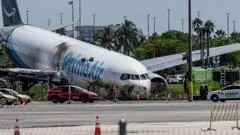
The National Transportation Safety Board released new flight data on the Amazon Prime Air crash in Miami showing repeated pilot warnings about excessive speed. The Boeing 767-300 touched down at 158 knots with inconsistent crew response and late flap use. Five ground workers died when the aircraft overran the runway, struck vehicles and caught fire. The update covers cockpit conversation summaries, automated alerts and the sequence of the runway overrun.
What does the NTSB update reveal about the approach?
The NTSB report summarises cockpit voice and flight data recorder information from the final minutes of Amazon Prime Air Flight 7598. One pilot repeatedly cautioned the other about the aircraft’s high speed while the plane descended toward Miami runway. The data recorder logged a landing speed of 158 knots, described by the board as on the high end for the Boeing 767-300. An altitude warning and a “sink rate” callout activated during the approach. The second pilot’s responses to the speed cautions were described as inconsistent throughout the recording. Flap deployment occurred later than normal in the sequence, limiting the aircraft’s ability to reduce speed and maintain a stable descent profile. The update also included the summary of conversation between the two pilots noting that the cautions about speed occurred throughout the remainder of the recording as did the inconsistent verbal response. The presence of these elements together indicates the approach remained unstable into the final moments before touchdown. The NTSB continues to review how the combination of speed, configuration and response contributed to the outcome while the full cockpit voice recording has not been released. The flight data included the plane’s speed, altitude, and other details like flap deployment as it approached the runway, providing investigators with a timeline of the high-speed descent that ended in the overrun. The data recorder captured the exact moment the aircraft crossed the runway threshold still travelling at 158 knots, confirming the excessive speed persisted until touchdown. This single figure anchors the entire sequence of events that followed.
How did the runway overrun unfold after touchdown?
After landing long, the aircraft continued past the runway end and struck ground equipment. It then hit a white Ford van carrying a plane-cleaning crew, broke through a perimeter fence and collided with a Toyota Corolla. The wreckage came to rest roughly 1,300 feet beyond the runway threshold. The five people killed were the occupants of the van. Miami authorities later identified them as Rolando Aleman Leon, 55; Yoel Rodriguez Naranjo, 53; Julio C Pineda, 75; Carlos Acosta Fajardo, 53; and Javierkys Reyes Quevedo, 47. Five other people on the ground were injured. The sequence shows the aircraft struck equipment on the ground first, then the van, continued onward through the fence and struck the Toyota Corolla before stopping. The NTSB data confirms the path and final position but does not yet provide a complete timeline of crew actions after the overrun began. The plane overshot the runway, crashed into other vehicles and burst into flames, ending 1,300ft beyond the runway after the chain of collisions. The final resting point 1,300 feet past the runway end illustrates the momentum carried by the aircraft at the moment it left the paved surface.
Why is flap timing and crew communication under scrutiny?
Aviation attorney Pablo Rojas told CBS News that the late flap deployment noted in the data could indicate the crew was still trying to manage excess speed. Flaps help increase lift and drag to slow the aircraft for landing. When they are extended late, the aircraft may remain fast and high on the approach. Rojas also noted that the NTSB reference to an “inconsistent verbal response” is difficult to interpret without the full audio recording. The summary does not yet clarify whether the response was absent, partial or delayed. Both the speed warnings and the flap data remain areas the NTSB will examine further. The attorney observed that without the actual recording it is hard to know exactly what the board means by inconsistent verbal response. This leaves open questions about the level of coordination in the cockpit during the high-speed descent. The flap data adds another layer because late deployment aligns with efforts to correct speed but may have left insufficient time for a stable landing configuration. The flap deployment data included in NTSB’s update also could be an area of concern because the flaps are part of what helps the plane slow down and gently approach a landing. Late extension therefore kept the aircraft in a high-energy state until it was too late to stabilise the approach.
What automated warnings were recorded?
The flight data showed an electronic “sink rate sink rate” callout and a “too low terrain” alert in the final minutes. These warnings are designed to alert crews when descent rate or ground proximity is outside safe parameters for the aircraft configuration. The presence of both alerts aligns with the high approach speed and the late configuration changes already noted in the recorder data. The NTSB has not yet released the full cockpit voice recording or the complete timeline of crew actions. The automated calls occurred alongside the pilot cautions about speed, reinforcing that multiple systems were indicating an unsafe profile. Investigators will continue to analyse how these alerts fit into the broader sequence of events. There was also an electronic “too low terrain” callout, another automated verbal warning that the plane was flying too close to the ground without being properly prepared for landing. The two electronic warnings therefore supplied independent confirmation that the aircraft was both descending too rapidly and remaining too fast for the runway environment.
Frequently asked questions
What caused the Amazon cargo plane to overrun the runway?
Preliminary NTSB data points to excessive landing speed of 158 knots combined with late flap deployment and limited crew response to speed warnings.
How many people died in the Miami plane crash?
Five ground workers inside a van struck by the aircraft after it left the runway were killed; five others were injured.
Which aircraft model was involved in the crash?
The aircraft was a Boeing 767-300 operating as Amazon Prime Air Flight 7598.
Who is leading the official investigation?
The US National Transportation Safety Board is leading the investigation and released the initial flight data update.
Has the full cockpit voice recording been released?
No. The NTSB has so far published only a summary of cockpit conversation and selected flight parameters; the complete recording remains with investigators.
Key takeaways
The NTSB recorded a 158-knot landing speed for the Boeing 767-300. One pilot issued repeated speed warnings that received inconsistent replies. Flaps were extended later than normal in the approach. The aircraft overran the runway, struck a van and a car, and came to rest 1,300 feet beyond the threshold. Five ground workers died and five others were injured. The NTSB continues to examine crew actions and aircraft configuration.
The investigation remains active. Additional data and analysis will be required before final conclusions on contributing factors are issued.