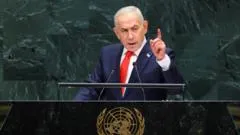
The Netanyahu UN speech at the 2026 General Assembly was marked by intense confrontation and a mass walkout of delegates. Israeli Prime Minister Benjamin Netanyahu defended military campaigns in Gaza, Iran, and the West Bank, rejecting allegations of genocide. While Netanyahu vowed to continue fighting, Palestinian President Mahmoud Abbas warned that Israeli settlement expansion threatens Palestinian existence. The address occurred amid significant regional tension, including joint US-Israeli strikes on Tehran earlier this year. This article examines the reactions to the speech, the conflicting claims regarding casualties, and the domestic political implications for Netanyahu.
How did the Netanyahu UN speech unfold amidst diplomatic tension?
The Netanyahu UN speech was characterized by immediate friction, as dozens of international delegates walked out of the hall in protest as the Israeli Prime Minister took the stage. Rather than retreating, Netanyahu responded to the mass departure by challenging those remaining in the room, labeling them "moral cowards" if they did not also exit. He maintained a stance of absolute defiance, asserting that Israel has no choice but to continue its military operations to ensure victory.
This confrontational atmosphere set the tone for a session that highlighted the deep divisions within the United Nations regarding Israel's current military posture. Netanyahu's rhetoric was not merely defensive; it was an offensive critique of his international detractors. He specifically targeted nations such as Britain and France, accusing them of hypocrisy regarding the concept of colonialism.
The significance of the delegate walkout
The walkout serves as a visible symbol of the growing international isolation facing the Israeli leadership. While Netanyahu views the departure of delegates as a sign of moral weakness, many observers see it as a formal rejection of the ongoing military campaigns in Gaza and the West Bank. The incident underscores the difficulty of finding common diplomatic ground at the UN General Assembly when one member state's actions are viewed by a significant portion of the assembly as violations of international law.
What were the conflicting claims made by Mahmoud Abbas?
Mahmoud Abbas, the Palestinian President, delivered a recorded message to the UN expressing grave concerns about the survival of the Palestinian people. Because he was denied a US entry visa, Abbas addressed the assembly via video link. He argued that Israeli policies, particularly the expansion of Jewish settlements in the occupied West Bank, are directly jeopardizing the viability of a two-state solution and the very existence of Palestinians on their homeland.
Abbas's address provided a sharp contrast to Netanyahu's narrative, as he accused the Israeli military of conducting a "genocidal war" characterized by starvation, destruction, and attempts at forced displacement. His comments focused on the humanitarian catastrophe in Gaza, framing the conflict not as a matter of self-defense, but as an existential threat to the Palestinian population.
How did the speakers address the allegations of genocide?
Netanyahu used his platform to explicitly reject accusations that Israel is committing genocide in the Gaza Strip. He framed Israel's actions as necessary for survival and security, particularly following the Hamas attacks of October 7, 2023. This rejection stands in direct opposition to findings from international bodies and scholars.
According to the International Association of Genocide Scholars (IAGS), Israel's conduct in Gaza meets the legal criteria for genocide as defined by the UN convention. Furthermore, the Hamas-run health ministry in Gaza reports that more than 73,920 people have been killed during the military campaign. Netanyahu, who is currently subject to an International Criminal Court arrest warrant for alleged war crimes, continues to maintain that these operations are legitimate acts of self-defense.
Discrepancies in settler violence statistics
A significant point of contention during the speech involved the level of violence occurring in the West Bank. Netanyahu attempted to downplay the impact of Jewish settler actions, suggesting that perhaps only "two or three" people are killed annually in such contexts. However, official United Nations figures tell a different story. According to the UN, 23 Palestinians have been killed in the context of settler attacks so far this year, with the total reaching 72 since the start of 2023. This discrepancy highlights the fundamental disagreement between the Israeli government and international observers regarding the security situation in the occupied territories.
What were the geopolitical implications of the speech?
The Netanyahu UN speech extended far beyond the halls of the UN, touching on volatile relationships with Turkey and the United States. Netanyahu labeled Turkish President Recep Tayyip Erdogan a "tyrant," accusing him of providing support to Hamas. This prompted a swift rebuke from the Turkish presidency, which stated that Netanyahu's use of the UN podium to make "baseless accusations" was incompatible with the ideals of peace and dialogue.
Regarding the United States, Netanyahu's speech appeared carefully calibrated for an American audience. He expressed gratitude to President Donald Trump for his "bold leadership," specifically referencing the joint US-Israeli air strikes against Tehran in February. This reference serves to reinforce the strategic alliance between the two nations, even as public support for Israel faces increasing scrutiny among the US Democratic base and certain segments of the Republican electorate.
How does the UN address affect Netanyahu's domestic standing?
The Netanyahu UN speech is closely tied to the political survival of the Prime Minister in Israel. With a critical election approaching next month, Netanyahu is attempting to rebuild his image as a security-focused leader. His "Mr. Security" persona has been under intense scrutiny following the October 7 attacks, with political opponents questioning whether he ignored crucial warnings regarding potential Hamas aggression.
The defiance shown at the UN is likely a strategic move to appeal to his domestic base. By positioning himself as the only leader capable of standing up to a hostile international community, he hopes to counteract the fact that his religious-right wing coalition is currently trailing in the polls. The speech acts as a campaign tool, intended to project strength to both Israeli voters and a skeptical American public.
Frequently asked questions
Why did Palestinian President Mahmoud Abbas address the UN via video?
Mahmoud Abbas was forced to use a video link because he was denied an entry visa to the United States. This prevented him from delivering his message to the General Assembly in person, despite the importance of his warnings regarding Palestinian survival and the two-state solution.
What is the status of Netanyahu's legal standing at the ICC?
Benjamin Netanyahu is currently subject to an arrest warrant issued by the International Criminal Court (ICC). The warrant is related to alleged war crimes committed during military operations. This legal reality adds a layer of international tension to his diplomatic engagements at the United Nations.
How do UN figures differ from Netanyahu's claims on settler violence?
Netanyahu claimed that settler-related violence results in only a few deaths per year. However, United Nations data indicates that 23 Palestinians have died in settler-related incidents this year, and 72 have died since the beginning of 2023, showing a much higher frequency of violence.
What was the response from Turkey to Netanyahu's remarks?
The Turkish presidency's communications director, Burhanettin Duran, responded by calling Netanyahu's accusations against Turkey "baseless." He stated that using the UN General Assembly to level such attacks was inconsistent with the international community's goals of law, peace, and constructive dialogue.
How did the speech address the US-Israel relationship?
Netanyahu specifically praised US President Donald Trump for his leadership, highlighting the joint air strikes conducted against Iran in February. This was seen as a strategic effort to maintain American support amidst growing political fractures and skepticism regarding Israel's military actions in the region.
Key takeaways
- Netanyahu rejected genocide allegations despite findings from the International Association of Genocide Scholars.
- UN data reports 72 Palestinian deaths from settler attacks since the start of 2023.
- President Mahmoud Abbas warned that settlement expansion threatens Palestinian existence via video link.
- Netanyahu's speech targeted both domestic voters and a divided American political landscape.
- The address followed significant regional escalation, including joint US-Israeli strikes on Iran.
The evolving landscape of Middle East diplomacy
The Netanyahu UN speech reflects a period of extreme volatility in Middle Eastern geopolitics. The intersection of domestic electoral pressure in Israel, the humanitarian crisis in Gaza, and the shifting attitudes of global powers like the United States creates a complex diplomatic environment. As Netanyahu seeks to consolidate his leadership through a policy of defiance, the international community remains deeply divided on the legality and morality of Israel's military strategies. The upcoming Israeli elections and the ongoing regional tensions will likely determine whether this period of confrontation leads to a new diplomatic equilibrium or further escalation.