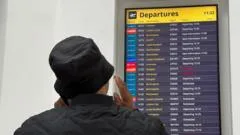
A major connectivity issue at the Prestwick control centre has triggered a fresh wave of flight delays and cancellations across the UK. This second significant technical failure has caused widespread disruption for passengers and operators alike. As the scale of the outage becomes clear, airlines are intensifying their calls for urgent leadership reform at Nats. The industry is demanding more stability and better infrastructure to prevent such recurring incidents from paralyzing the national airspace and damaging consumer confidence in the aviation network.
What caused the recent air traffic control disruption in the UK?
A connectivity issue at the National Air Traffic Services (Nats) control centre in Prestwick, Ayrshire, was the primary driver of Monday's flight disruptions. Unlike the previous software defect experienced at the Swanwick centre in Hampshire, this incident was localized to the northern sector of the UK's airspace. The Prestwick facility manages approximately 42% of all UK air traffic, overseeing routes across northern England, Scotland, and Northern Ireland.
Nats officials have explicitly stated that the Prestwick connectivity problem is unrelated to the software glitch that occurred in early September. That earlier incident at Swanwick—which handles southern airspace, including major hubs like Heathrow and Gatwick—involved a millisecond-long software error that produced corrupted data, leading to the cancellation of roughly 2,000 flights. While the Prestwick issue has since been resolved and the system is back at full capacity, the airline industry remains concerned about the frequency of these technical failures.
Comparing the Prestwick and Swanwick incidents
The distinction between the two recent failures is critical for understanding the current state of UK airspace management. While the Swanwick event was a software-driven error affecting long-haul and intercontinental travel, the Prestwick incident was categorized as a connectivity issue. However, the cumulative effect of both has created a perception of systemic instability within the Nats infrastructure. The Swanwick disruption was noted as being much more severe because it impacted the vital approaches to major international airports, whereas the Prestwick issue, while causing significant delays in the north, was a different technical failure altogether.
How heavily did airlines and passengers feel the impact?
The scale of the disruption varied significantly between carriers, with EasyJet experiencing the most substantial operational impact. According to data from aviation analytics company Cirium, as of 13:45 BST on Monday, the disruption affected at least 200 flights. This total included 100 flights scheduled to arrive in the UK and 99 that were due to depart. EasyJet was the worst affected airline, with 47 of its 670 scheduled departures cancelled.
In contrast, British Airways reported a relatively lower impact, with 11 cancellations out of its 513 scheduled departures. Ryanair was also severely affected, reporting that the outage impacted 140 of its flights and affected approximately 25,000 passengers. For many travelers, the disruption caused immediate logistical hardship and confusion. Reports from passengers included being stranded at airports or receiving conflicting information regarding flight statuses while in transit to terminals. One passenger, Nicole McCloskey, noted that her family received a message saying a flight was delayed while they were travelling to Glasgow, only to find out it was grounded once they arrived. Another traveler, Steve Davies, expressed frustration that such technical issues seem to be "happening a lot."
Why is there a growing call for Nats leadership reform?
Airlines and industry bodies are increasingly vocal in their criticism of Nats, with several leaders calling for urgent structural changes. Wizz Air UK Managing Director Yvonne Moynihan described the situation as a "national confidence crisis" and questioned the effectiveness of both the current leadership and the board of directors. The sentiment is echoed by Ryanair, which has reiterated calls for the resignation of Nats chief Martin Rolfe, citing a failure to provide a reliable system or an effective backup mechanism.
The pressure on Nats management has intensified following two significant failures in less than a fortnight. While Martin Rolfe has maintained that he will not resign, arguing that the previous software defect was "very, very obscure," the industry's patience appears to be waning. Jet2 boss Steve Heapy has demanded "urgent and accountable" action to bolster the UK's air traffic control infrastructure, suggesting that the current level of resilience is insufficient for modern aviation demands. EasyJet also noted that the incident "once again calls into question the resilience" of the service.
The role of the Nats Board and Executive
The debate is shifting from technical troubleshooting to corporate governance. Critics are not only focusing on the immediate technical failures but are also scrutinizing the oversight provided by the Nats board. When asked by BBC Radio 4's World at One programme whether Martin Rolfe should resign, Moynihan emphasized the need to look at the leadership at the top, but added, "But more than that, what are the board of directors doing?" This highlights a growing demand for accountability that extends beyond the immediate technical causes to the strategic management of the UK's airspace.
Are passengers entitled to compensation for these delays?
Passengers affected by the recent air traffic control disruption are unlikely to receive financial compensation under current passenger rights regulations. The UK Civil Aviation Authority (CAA) indicated that the technical issues experienced by Nats would likely be classified as "extraordinary circumstances." This legal distinction is vital for determining liability in aviation law.
Under these rules, while airlines are obligated to provide "duty of care"—such as food, refreshments, and accommodation if necessary—they are generally not required to pay monetary compensation for delays or cancellations caused by events outside their direct control. Because the fault lies with the air traffic control provider rather than the airline's own operational or staffing issues, the financial burden of the disruption typically falls on the airlines and the passengers themselves, rather than the service provider being held liable for individual passenger claims.
Key takeaways
- A connectivity issue at the Prestwick Nats centre caused major flight disruptions across northern UK airspace, including Scotland, Northern Ireland, and northern England.
- At least 200 flights were cancelled or did not fly on Monday, with EasyJet being the most impacted (47 cancellations).
- The incident is distinct from the Swanwick software defect that cancelled 2,000 flights earlier in September.
- The UK Civil Aviation Authority classifies these technical failures as "extraordinary circumstances," meaning passengers are unlikely to be entitled to compensation.
- Airlines, including Wizz Air and Ryanair, are calling for urgent reform and leadership changes at Nats.
FAQ: Air traffic control disruption
What was the cause of the Monday flight delays?
The disruption was caused by a connectivity issue at the National Air Traffic Services (Nats) control centre in Prestwick, Ayrshire. This technical failure affected airspace across Scotland, Northern Ireland, and northern England, leading to dozens of flight delays and cancellations.
Can I claim compensation for my cancelled flight?
Passengers are unlikely to be entitled to compensation because the CAA views these technical failures as "extraordinary circumstances." While airlines must still provide care, such as food or accommodation, they are not legally required to pay financial compensation for delays caused by air traffic control issues.
How does Prestwick differ from Swanwick?
Prestwick manages approximately 42% of UK air traffic, focusing on northern England, Scotland, and Northern Ireland. Swanwick manages the southern airspace, including the major approaches to London Heathrow and Gatwick, and was the site of a separate software error earlier this month.
Which airlines were most affected by the outage?
EasyJet was the most heavily impacted, with 47 cancellations out of 670 scheduled departures. Ryanair also reported significant disruption, affecting 140 flights and roughly 25,000 passengers, while British Airways saw a smaller impact of 11 cancellations.
What is the industry's response to Nats?
Airlines have expressed deep dissatisfaction, with Wizz Air and Ryanair calling for urgent reform and leadership changes. Industry representatives argue that the frequency of these failures indicates a lack of resilience and effective backup systems within the UK's air traffic infrastructure.
Conclusion
The recent technical failure at the Prestwick Nats centre has exacerbated an existing crisis of confidence within the UK aviation sector. With two significant disruptions occurring in less than a month, the focus has shifted from immediate technical resolution to a broader debate regarding the accountability and resilience of air traffic control infrastructure. While Nats has restored services to full capacity, the legal classification of these events as extraordinary circumstances leaves passengers with limited recourse for compensation. Moving forward, the industry's demand for structural reform and improved leadership will likely remain a central issue in UK aviation policy.