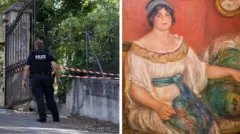
Museum thefts Europe have increased since the October 2025 Louvre burglary that removed €88 million in jewellery. Europol reports a rise in cases over the past two years, with more forceful entry methods and a shift toward portable high-value items. The latest incident at the Renoir Museum in Cagnes-sur-Mer saw four paintings taken in five minutes. This article examines the pattern, the reasons museums are targeted, changing targets, recovery prospects and the practical steps institutions are taking to deter further raids.
Why have museum thefts Europe increased since 2025?
Europol data supplied to the BBC shows museum theft reports across Europe began rising around 2024. The agency links the trend to the successful Louvre operation, after which smaller institutions faced copycat attempts within hours. Arthur Brand, an art recovery specialist, told the BBC that the visibility of the Louvre raid encouraged offenders to view local museums as viable targets containing gold, silver and portable artefacts. Within hours of the Louvre burglary, thieves had already raided coins from a smaller museum in France. Since then, further incidents have included a diamond necklace in Vienna, Bronze Age artefacts in Spain, and art taken from two Italian museums. Europol tells the BBC the number of museum theft cases reported to them across Europe began to increase about two years ago. Its recent report says both the methods and targets of thefts are changing, with a rise in more forceful tactics and a focus on high-value items such as precious metals and gemstones. The Association for Research into Crimes against Art says the recent thefts show a repeated preference for small, portable, immediately accessible objects and for attacks designed to be completed in minutes. Data provided to the BBC by ARCA shows recorded museum thefts in France spiked in 2024 and rose again slightly in 2025. While numbers go up and down over time, with more thefts recorded in 2015 than a decade later, the recent spike coincides with a change in tactics. Offenders now use power tools, electric knives and mechanical lifts rather than relying solely on deception. Both Brand and museum security expert Ibrahim Bulut believe many thefts that followed the Louvre burglary are copycats. Every museum in the world is stressing now, Brand says, and in every museum there have been meetings with the security officer or with the police.
What items are now preferred by thieves?
Paintings remain targets but are harder to sell. Thieves have shifted toward precious metals, gemstones and culturally significant objects such as Chinese porcelain. Europol notes that metals can be melted without leaving traceable evidence, while stones can be removed from settings for separate sale. The Renoir paintings taken in Cagnes-sur-Mer were dropped in the museum garden, suggesting the thieves lacked immediate buyers. Earlier incidents included a diamond necklace in Vienna and Bronze Age artefacts in Spain. These items match the profile of goods that can be disposed of quickly on secondary markets. Europol states that precious metals can be easily melted down, leaving no trace for law enforcement, and facilitating illicit sales during the fencing process. Precious stones in jewellery, on the other hand, can be easily removed and sold further. Chinese porcelain is likely to be easily sold on the art market because of high demand. While paintings are still taken, they are harder to sell, so about 10 years ago thieves began shifting to goods that are easier to get rid of, Brand says. The heist at the Renoir Museum in Cagnes-sur-Mer is the latest, and detectives are still working to track down the remaining multi-million-pound paintings, two of which were quickly recovered after thieves dropped them in the museum garden.
How long do police have to recover stolen items?
Brand states investigators typically have four to six days before stolen goods are moved beyond easy reach. Informants and public tips remain key sources of information. However, only 5 to 10 percent of stolen art is ever recovered, according to Christopher A Marinello of Art Recovery International. The Louvre jewellery remains missing nearly a year later. After a theft, police generally have between four and six days to catch the thieves, according to Brand, who works with investigators by calling informants and receiving tips from the public or even ex-partners of perpetrators. But while suspects may be arrested, jewels or precious metals might not be found, such as with the Louvre case. On the other hand, Brand believes the Renoir paintings stolen this week will probably be recovered because no one will want to buy them and it is likely that the thieves have no idea what to do with them. Christopher A Marinello says only 5-10% of stolen art is ever recovered, making thefts from small museums like this week's extra painful. Tuesday's heist is another example of Europe's museums under siege, he adds.
What security changes are museums implementing?
Institutions are adding physical delays such as reinforced doors, thicker display glass and fog machines. Integrated alarm systems can now lock down high-value areas automatically. The Museum of Applied Arts in Vienna introduced metal detectors, mandatory bag storage and extra guards after its own burglary. Training for staff to identify suspicious visitors is also being expanded. Funding remains a constraint for smaller cities. The mayor of Langres noted that local authorities must balance heritage rules with modern protection needs while lacking the budgets of major national museums. After its theft in October, Maison des Lumières launched a security audit carried out by police officers appointed by France's cultural ministry. Some recommendations are already being implemented, such as enhanced video surveillance, while other structural improvements are in the process of being developed. MAK in Vienna also increased its security to prevent copycat offenders and to provide our audience with visible security, its director says. Entry is through a metal detector, and bags must be put in the cloakroom or in lockers, and there are more security guards. Experts say the trick is to create physical barriers that will delay thieves so there is time for the police to arrive, or to make any theft take so long that it would deter would-be offenders from attempting it. Security is about buying time, says Bulut. The objective is not to make the theft theoretically impossible, but to make removal difficult, noisy, detectable and above all, time-consuming, because to be very honest, thefts can always happen, it's the timing that you're concerned about. Brand says a delay could be building an extra, heavy door anchored into the ground, thickening the glass on display cases or using a fog machine. Sokka says it's critical to have integrated systems, so for example if an alarm goes off, you could shut down the facility, or lock down all high net worth paintings. However, security measures are expensive. Mayor Caviezel, whose small French city hosts two museums and collections, says finding the money is one of our main challenges. A small city can be entrusted with collections of national importance without having the financial resources of a major Parisian institution. Bulut says it's not all about expensive gadgets. It could also be training guards to spot suspicious people who may be casing a museum and ask them if they need help, which may deter them from returning. Museums are investing: Sokka says his company has seen an uptick in seismic offerings, that can detect vibration such as drilling in walls, in the past 18 months.
Frequently asked questions
Are museum thefts Europe limited to large institutions?
No. Recent cases show both national museums and smaller regional sites have been targeted, often within days of high-profile successes.
Can museums become fortresses without closing to the public?
Directors state that complete lockdown is not feasible. The goal is to extend the time required for any theft so police can respond before items leave the premises.
Why are colonial artefacts mentioned in theft discussions?
Some commentators note that certain high-value items originate from outside Europe. This does not change the legal status of the objects or justify theft under current law.
Do all countries show the same increase?
Sweden has recorded a decline in major museum thefts over the past decade. The pattern is therefore not uniform across the continent.
What happens to recovered paintings like the Renoir works?
Specialists expect the dropped canvases to be returned because they lack ready buyers and are easily identified.
Key takeaways
- Europol recorded rising museum theft reports across Europe from 2024 onward.
- The October 2025 Louvre burglary removed €88 million in jewellery that remains missing.
- Thieves now favour precious metals and gemstones that can be quickly altered or sold.
- Only 5 to 10 percent of stolen art is recovered according to recovery specialists.
- Security upgrades focus on time delays rather than absolute prevention.
Outlook for European museums
Museums must increase protection while remaining accessible. Experts emphasise that visible security measures, staff training and integrated alarm systems can raise the risk and time cost for offenders. Continued cooperation between institutions, police and specialist investigators will determine whether the recent wave of incidents can be contained. The challenge for museums now is increasing security while also staying open to the public. A museum cannot be a fortress, Hollein says. We want to be open institutions; at the same time, we are facing new challenges and attacks against museums that will require new standards.