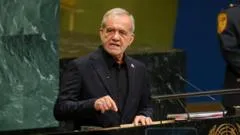
The Iran US conflict has reached a critical diplomatic juncture following President Masoud Pezeshkian's address to the UN General Assembly. Responding to US President Donald Trump's recent threat to "annihilate" the Islamic Republic if a deal is not reached, Pezeshkian asserted that Iran will never "bend the knee" despite seven months of ongoing warfare. The Iranian leader expressed readiness for diplomacy but insisted that any resolution must include the removal of the US blockade on Iranian shipping. This article examines the recent UN developments, the status of the Strait of Hormuz, and the core demands preventing a permanent ceasefire.
How did President Pezeshkian respond to US threats at the UN?
President Masoud Pezeshkian utilized his platform at the United Nations General Assembly to issue a firm rejection of the rhetoric used by US President Donald Trump. Addressing the assembly, Pezeshkian characterized the American president's ultimatum—which offered a choice between a rebuilding deal or the "annihilation" of the Islamic Republic—as a manifestation of a "bullying mentality."
The Iranian leader emphasized that external pressures are unlikely to force a surrender. According to Pezeshkian, the resistance of the Iranian people is expected to intensify rather than diminish when faced with sanctions, increased military pressure, or perceived bullying from global powers. He framed the current state of the nation not as one of aggression, but as one of victimhood, stating, "The US president described us as terrorists. We have been the victims of terrorism."
The tension was underscored by a significant diplomatic gesture: the US delegation walked out of the chamber at the commencement of Pezeshkian's speech. This walkout highlights the profound breakdown in bilateral relations as both nations remain locked in a high-stakes confrontation that has lasted nearly seven months.
The symbolic weight of the UN address
To illustrate the human cost of the conflict, Pezeshkian presented visual evidence to the assembly. He held up a photograph of the late Supreme Leader, Ayatollah Ali Khamenei, who was killed during a joint US-Israeli strike on his residence in late February. Furthermore, he displayed images of civilian casualties, specifically referencing over 175 individuals—two-thirds of whom were children—allegedly killed in missile strikes on a primary school in Minab and a sports complex in Lamerd. While the US has denied striking Lamerd and maintains an ongoing investigation into the Minab incident, the Iranian administration uses these images to reinforce their narrative of "cowardly attacks" and unprovoked aggression.
What are the primary obstacles to a diplomatic solution?
The most significant logistical and economic barrier to a lasting peace is the ongoing US blockade of Iranian maritime access. Pezeshkian made it explicitly clear that no sustainable agreement can be reached unless the US lifts the restrictions preventing Iranian ships from utilizing vital waterways.
The core of the dispute involves the Strait of Hormuz, a critical chokepoint for global energy markets. Pezeshkian argued that the current status quo, where the international community benefits from the waterway while Iran is denied access, is untenable. He stated, "It cannot be the case that everyone benefits from the Strait of Hormuz while we are denied access to shipping through this waterway."
The history of this maritime dispute is cyclical. In February, Iran retaliated against US-Israeli air campaigns by launching missile and drone strikes against Israel and US-hosted military bases in the Gulf. This period saw Iran effectively close the Strait of Hormuz—through which approximately one-fifth of global oil and gas shipments pass—by targeting commercial vessels. The US responded in April with a blockade of Iranian ports. Although a preliminary agreement was reached in June to reopen the strait, it collapsed within weeks following renewed Iranian attacks on shipping and the subsequent reinstatement of the US blockade.
The dispute over maritime control and fees
A fundamental point of contention remains the level of control Iran seeks over the Strait of Hormuz. Iranian officials have expressed a desire to maintain a measure of sovereignty over the waterway, including the right to collect fees from vessels passing through. The United States has consistently rejected this demand, viewing it as a threat to the freedom of navigation and global energy security. This disagreement over revenue and regulation remains a primary deadlock in the negotiation process.
What is Iran's position on its nuclear programme?
Despite the intense military pressure, Iran has reiterated its stance on its nuclear capabilities, insisting on the right to pursue peaceful technology while denying any intent to weaponize it. Pezeshkian sought to clarify this position to the international community, aiming to separate civilian scientific advancement from military ambitions.
The Iranian presidency stated clearly that while they will not accept limitations on peaceful nuclear technology, they have no intention of developing nuclear weapons. "We say it clearly: no nuclear weapons and no limitations on peaceful nuclear technology," Pezeshkian declared. This stance directly contradicts the position held by the Trump administration, which has demanded that Iranian leaders completely relinquish their nuclear ambitions, arguing that the ongoing war has been necessary to prevent Iran from obtaining a nuclear bomb.
How are current diplomatic negotiations progressing?
While official rhetoric remains hostile, indirect diplomatic channels have seen recent activity on the sidelines of the UN General Assembly in New York. These discussions represent the first direct engagement between US and Iranian representatives since June.
The talks involved Iranian Foreign Minister Abbas Araghchi and US envoy Steve Witkoff, with Qatari mediators facilitating the process. According to Witkoff, there is hope that these discussions will prove to be "constructive and promising." However, the Iranian perspective on these meetings is significantly more cautious.
Esmail Baqai, a spokesperson for the Iranian foreign ministry, characterized the talks as "not anything new." He indicated that Araghchi has maintained Iran's non-negotiable conditions for a deal, which include:
- The immediate end to the US naval blockade.
- The release of frozen Iranian financial assets.
- The restoration of maritime access through the Strait of Hormuz.
As of the latest reports, the gap between the US demand for total nuclear relinquishment and Iran's demand for the removal of economic and maritime blockades remains vast, leaving the future of the conflict uncertain.
Frequently asked questions
What is the current status of the Strait of Hormuz?
The Strait remains a volatile flashpoint in the conflict. While it is a vital artery for one-fifth of global oil and gas, it is subject to a US blockade of Iranian vessels and periodic attacks on commercial shipping by Iranian forces, complicating global energy transit.
Why did the June peace agreement fail?
The preliminary agreement reached in June collapsed within weeks. The failure was attributed to a resumption of Iranian attacks on commercial shipping in the Gulf and the Arabian Sea, which prompted the United States to reinstate its blockade of Iranian ports.
What are Iran's main demands for a ceasefire?
Iran's primary requirements for a diplomatic settlement include the lifting of the US maritime blockade, the unfreezing of Iranian assets, and the preservation of their right to a civilian nuclear programme without international limitations.
What has the US said regarding civilian casualties in Iran?
The US has denied responsibility for specific strikes, such as those in Lamerd, and has stated that it is currently investigating the circumstances surrounding reported civilian deaths in locations like Minab. The administration maintains its focus on targeting military and terrorist entities.
Who is mediating the current talks?
Qatar is currently serving as the primary mediator for the indirect talks between US envoy Steve Witkoff and Iranian Foreign Minister Abbas Araghchi. These discussions are taking place on the sidelines of the UN General Assembly in New York.
Key takeaways
- President Pezeshkian rejected US "annihilation" threats, stating Iran will not "bend the knee."
- A major deadlock exists over the US blockade of Iranian shipping in the Strait of Hormuz.
- Iran demands the release of frozen assets and end to maritime restrictions for any deal.
- The US and Iran are engaged in indirect talks brokered by Qatari mediators in New York.
- Iran maintains its right to peaceful nuclear technology while denying nuclear weapon ambitions.
The path toward de-escalation
The current standoff between Iran and the United States represents a precarious balance between military brinkmanship and cautious diplomacy. While President Trump's rhetoric suggests a preference for decisive, potentially destructive action, the indirect talks in New York provide a narrow window for a negotiated settlement. However, the fundamental disagreements regarding maritime sovereignty in the Strait of Hormuz and the scope of Iran's nuclear programme suggest that any lasting peace will require significant concessions from both sides. Until the core issues of the blockade and nuclear restrictions are resolved, the risk of renewed large-scale conflict remains high.