Houthi attacks on Riyadh and critical energy infrastructure along the Saudi Red Sea coast occurred on Saturday, marking a significant escalation in regional hostilities. Iran-backed militants deployed a combination of drones and ballistic missiles targeting the capital and Aramco facilities in Yanbu. While Saudi authorities reported the successful interception of a ballistic missile aimed at Riyadh, reports of explosions and fuel tank fires near King Khalid International Airport caused temporary flight disruptions. This surge in violence follows an increase in Houthi strikes since July and has prompted warnings from the US State Department regarding travel risks. This article examines the military details of the strikes, the impact on Saudi energy security, and the broader humanitarian and economic consequences of the escalating Yemen conflict.
What happened during the Houthi attacks on Riyadh?
The Houthi military launched a coordinated strike involving a high volume of ballistic missiles, cruise missiles, and drones targeting sensitive locations within the Saudi capital. According to Houthi military spokesman Yahya al-Sarea, these strikes were aimed at Riyadh and Aramco state oil and gas facilities located in Yanbu on the Red Sea coast. The operation was described by the militants as a direct response to Saudi military actions against the Yemeni capital, Sanaa.
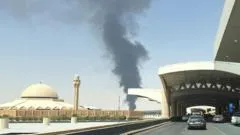
In Riyadh, the suddenness of the attack was marked by the sounding of air raid alerts, a development that had not occurred with such intensity since the Houthi offensive increased in July. Residents reported hearing significant explosions that caused windows to shake, contributing to a sense of alarm across the city. While the Saudi government confirmed the interception and destruction of at least one ballistic missile directed at the capital, the physical impact was visible near the city's international airport.
Impact on Riyadh's infrastructure and aviation
A column of black smoke was observed rising from fuel tanks near King Khalid International Airport during the incident. Reports indicated that firefighters were deployed to manage flames from a burnt-out Aramco fuel tank. This proximity to the airport led to immediate operational challenges, with tracking services like FlightRadar24 noting various flight delays and cancellations. The Saudi Civil Defence had previously issued overnight phone alerts to residents in Riyadh and surrounding regions, providing a warning before the official all-clear was issued on Saturday morning.
How has the conflict impacted Saudi energy security?
The targeting of Yanbu and other Red Sea coastal sites represents a direct threat to the stability of Saudi Arabia's energy export routes. By focusing on Aramco facilities, the Houthis are attempting to strike at the economic heart of the Kingdom. The strategic importance of these sites is heightened by recent shifts in maritime security, as Saudi vessels have increasingly relied on the Red Sea for oil exports to Asia and Europe following the closure of the Strait of Hormuz due to tensions between the US, Israel, and Iran.
The Houthis have recently expanded their maritime reach by seizing control of the strategic port city of Mokha and Perim Island. This move provides the group with a gateway to critical shipping routes. The militants have characterized this naval blockade as a retaliatory measure against a Saudi blockade of northern Yemeni ports and airports. This maritime dimension adds a layer of complexity to the conflict, as it moves the battlefield from land-based skirmishes to the vital arteries of global energy trade.
What is the impact of the escalating fighting on casualties and displacement?
The escalation in military activity has resulted in significant loss of life and a growing humanitarian crisis within Yemen. According to an unconfirmed report from the AFP news agency, citing military sources from both sides of the civil war, fighting on Saturday claimed 48 lives. The breakdown of these casualties shows the intensity of the combat: the Houthis reported 31 of their fighters were killed, while government sources stated they had lost 17 soldiers.
Beyond the immediate combat deaths, the broader population is facing unprecedented levels of instability. The International Organization for Migration (IOM), a UN body, reported on Friday that the number of people displaced by recent fighting has surpassed 104,796 individuals. This displacement highlights the long-term human cost of the civil war, which pits the Houthis against the internationally recognized government supported by a Saudi-led coalition.
Regional defense and military responses
The Saudi-led coalition has actively engaged in defensive operations to protect civilian centers. An official spokesperson for the coalition stated that air defenses successfully intercepted hostile attempts to target civilians in several cities, including Bish, Taif, Farasan, and Yanbu. These interceptions are part of a broader effort to mitigate the reach of Houthi missile and drone technology, which has become increasingly sophisticated in its ability to penetrate defended airspace.
Why are global markets struggling to predict the economic fallout?
The volatility introduced by the Houthi strikes on energy-producing regions has created deep uncertainty for global oil markets. Financial institutions are finding it difficult to quantify the long-term impact of the conflict on supply chains and price stability. The unpredictability of the "endgame" in this regional struggle makes traditional economic modeling nearly impossible for many analysts.
In a notable assessment, the investment banking firm JP Morgan stated that it is struggling to forecast how oil prices will react to the ongoing warfare. The firm informed investors that the current landscape is too complex to model accurately, particularly given the overlapping tensions involving Iran and the shifting maritime security protocols in the Red Sea. This uncertainty is compounded by the potential for rapid escalation, which could transition the conflict from localized strikes to a broader regional crisis affecting global energy costs.
Frequently asked questions
What triggered the Houthi attacks on Riyadh?
The Houthis stated the attacks were a response to Saudi military strikes against Sanaa, the Houthi-controlled capital of Yemen. They claimed the use of ballistic missiles and drones was necessary to retaliate against what they termed "criminal attempts" by Saudi forces to target their territory.
How did the attacks affect travel in Saudi Arabia?
The strikes caused significant disruptions at King Khalid International Airport in Riyadh, including flight delays and cancellations. Additionally, the US State Department advised Americans in the Middle East to prepare for potential flight cancellations and urged them to reconsider travel through the region.
Were the missiles successfully intercepted?
Saudi authorities confirmed that they intercepted and destroyed a ballistic missile fired toward Riyadh. Furthermore, a coalition spokesperson stated that air defenses successfully blocked hostile attempts to target civilians in several cities, including Taif, Yanbu, Farasan, and Bish.
What is the humanitarian situation in Yemen?
The humanitarian situation is critical, with the International Organization for Migration reporting that over 104,796 people have been displaced due to recent fighting. Combat casualties also remain high, with reports indicating dozens of deaths on both sides during recent escalations.
How does this affect global oil prices?
The attacks on Aramco facilities and Red Sea shipping routes create market volatility. JP Morgan has noted that the complexity of the conflict makes it extremely difficult to model or predict the eventual impact on global oil prices.
Key takeaways
- Houthi militants targeted Riyadh and Aramco facilities in Yanbu with ballistic missiles and drones.
- Saudi air defenses intercepted a ballistic missile aimed at the capital during the Saturday strikes.
- Flight disruptions occurred at King Khalid International Airport following explosions and fuel tank fires.
- Displacement in Yemen has exceeded 104,796 people according to the UN's IOM.
- JP Morgan reported difficulty in modeling the impact of the conflict on global oil prices.
The evolving landscape of the Yemen conflict
The recent strikes on Riyadh and the Red Sea coast signal a dangerous shift in the Yemen civil war, moving from localized combat to direct threats against Saudi Arabia's economic and civilian infrastructure. The involvement of high-tech weaponry, such as ballistic missiles and drones, combined with the strategic seizure of maritime gateways like Mokha, suggests a more sophisticated and expansive Houthi military capability. As the humanitarian crisis deepens and global markets struggle to price in the risks of regional escalation, the conflict continues to threaten both local stability and international energy security. The ability of regional powers to contain these strikes will likely determine the next phase of the conflict.