The Board of Peace has officially unveiled a comprehensive $2.45bn Gaza recovery plan designed to address the territory's most urgent humanitarian and infrastructural needs. This ambitious initiative consists of 66 distinct programmes aimed at stabilizing the region. However, the project faces immediate and severe obstacles that could jeopardize its success. Most notably, there is a massive $18bn shortfall between the required capital and the actual funds received from international donors. Furthermore, ongoing political deadlock regarding the disarmament of Hamas continues to stall progress on the ground.
What does the $2.45bn Gaza recovery plan entail?
The initial $2.45bn allocation is designed to address the most urgent humanitarian requirements through 66 distinct programmes scheduled for implementation over the next six months. According to the Board of Peace, the primary focus of this immediate tranche includes the restoration of housing, the management of waste removal, and the provision of diesel generation to support critical infrastructure.
Jared Kushner, a Gaza Executive Board member and Trump's son-in-law, conceded that the Gaza Recovery Programme has faced "different delays on different things, for whatever reason." During a meeting of board members and stakeholders in New York, Kushner emphasized the organization's commitment to the initiative despite these setbacks. US envoy Steve Witkoff also joined the meeting, asserting that "real progress" has been made over the past year, noting that all hostages are home and a ceasefire, though imperfect, remains in place.
Despite the scale of this announcement, the board highlighted a significant discrepancy between pledged funds and actual capital received. While international stakeholders have pledged a total of $18bn, only $280m has been officially handed over. This liquidity gap poses a major challenge to the long-term vision of the initiative, as the board continues to look for more participating countries to step forward with financial assistance.
The long-term financial outlook
The Board of Peace has projected that the total cost for the full recovery and reconstruction of the Gaza Strip will reach roughly $71bn over the coming decade. This massive financial requirement necessitates sustained international cooperation and the fulfillment of existing pledges to move beyond emergency aid toward permanent rebuilding. US Secretary of State Marco Rubio noted that while a number of countries have already stepped forward with pledges, the board is actively seeking further participation to meet this decade-long requirement.
Why has the reconstruction timeline remained uncertain?
Reconstruction has yet to commence due to a political and military deadlock that has stalled the implementation of Trump's broader peace plan. While a ceasefire between Israel and Hamas has been in place for nearly a year, the transition from a cessation of hostilities to active rebuilding is hindered by unresolved security protocols.
A primary obstacle is the status of Hamas's weaponry. The Palestinian group has indicated a willingness to disarm in exchange for a phased withdrawal of Israeli troops from the 60% of Gaza currently under military occupation. In July, Hamas stated it had accepted a disarmament plan provided Israel ends "all forms of aggression" and withdraws its forces. However, this has been rejected by Israeli Prime Minister Benjamin Netanyahu, who insists the military will remain in Gaza until Hamas is "genuinely" disarmed. This disagreement has prevented the establishment of a definitive start date for reconstruction efforts.
What are the technical challenges to rebuilding Gaza?
Even if political consensus is reached, the physical environment in Gaza presents extreme engineering and safety challenges. Michael Eisenberg, an Israeli-American member of the Board of Peace, noted that the territory must first be cleared of hazardous materials before construction can begin. He explained that because Gaza remains a war zone, the immediate priority is the removal of unexploded ordnance.
The technical requirements for a safe rebuilding process include:
- Unexploded Ordnance: The removal of dangerous munitions left over from ongoing and past military operations.
- Tunnel Destruction: The neutralization of hundreds of kilometers of underground tunnel networks.
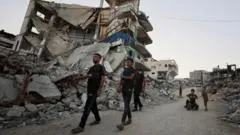
- Debris Management: The processing of an estimated 60 million tonnes of rubble resulting from the destruction of approximately 80% of all structures in the territory.
Eisenberg emphasized that only once these foundational safety and clearance tasks are completed can Gazans return to rebuilding essential infrastructure such as housing, sanitation, and utilities.
How severe is the current humanitarian situation?
The living conditions for the 2.1 million people in Gaza remain dire as the political deadlock continues. According to the United Nations, approximately 90% of the population—roughly 1.9 million people—has been displaced, many of them multiple times. The humanitarian crisis is characterized by several critical factors:
- Shelter Deficiencies: 1.2 million people are currently living in makeshift shelters or tents.
- Sanitation and Water: There is extremely limited access to clean water and basic sanitation services.
- Casualty Figures: Since the ceasefire began, the Hamas-run health ministry—figures considered reliable by the UN—reports that at least 1,408 Palestinians, including over 300 children, have been killed in Israeli strikes.
- Military Losses: The Israeli military reports that five of its soldiers have died in combat since the ceasefire, alongside one contractor killed in an operational accident.
Nickolay Mladenov, the Board of Peace's high representative for Gaza, has warned that any collapse of the existing ceasefire would represent a "point of no return" for the stability of the entire region. He has previously criticized both the continuing Israeli air strikes and the actions of Hamas.
What is the role of the Board of Peace?
The Board of Peace was established as a central component of Donald Trump's 20-point Gaza peace plan, which was originally unveiled alongside Israeli Prime Minister Benjamin Netanyahu in September last year. While initially conceived as a specialized international body to facilitate peace in Gaza, its mandate has since expanded to address various global conflicts.
The board's current mission involves several overlapping responsibilities:
- Fundraising and Resource Allocation: Coordinating with international donors to bridge the gap between the $18bn in pledges and the $280m actually received.
- Governance Oversight: Navigating the complex transition of Gaza's governance, which includes the idea of handing over control to Palestinian technocrats.
- Security Coordination: Seeking consensus between Israeli and Palestinian officials regarding security guarantees for those operating within the territory.
FAQ: Gaza Recovery Plan
What is the total estimated cost of Gaza's reconstruction?
The Board of Peace estimates that the full recovery and reconstruction of the Gaza Strip will require approximately $71bn over the next ten years. This covers the transition from immediate humanitarian aid to the long-term rebuilding of permanent infrastructure and housing.
How much funding has actually been received for the plan?
While international donors have pledged a total of $18bn, only $280m has been officially handed over so far. This significant shortfall remains a primary concern for the Board of Peace as they attempt to launch the 66 recovery programmes.
What is the main sticking point in the peace process?
The primary deadlock involves the disarmament of Hamas. Hamas has agreed to disarm in exchange for a phased Israeli troop withdrawal, but Israel insists on full disarmament before any military forces leave the 60% of Gaza they currently occupy.
What are the immediate priorities of the $2.45bn fund?
The immediate $2.45bn allocation is targeted at 66 programmes over six months. These focus on essential survival and recovery needs, specifically housing, diesel generation for power, and the removal of waste to improve sanitation.
Why can't rebuilding start immediately?
Rebuilding is delayed by security and technical hurdles. The territory must first be cleared of unexploded ordnance and hundreds of kilometers of tunnels must be destroyed. Additionally, the political impasse regarding the ceasefire and military presence must be resolved.
Key takeaways
- The Board of Peace has announced an initial $2.45bn Gaza recovery plan for 66 programmes.
- Total reconstruction costs for the next decade are estimated at $71bn.
- Only $280m of the $18bn pledged by international donors has been received.
- Security concerns, specifically Hamas disarmament, continue to stall the reconstruction timeline.
- Approximately 1.2 million Gazans are currently living in makeshift tents or shelters.
Conclusion
The $2.45bn Gaza recovery plan represents a significant attempt by the Board of Peace to transition from crisis management to structured reconstruction. However, the initiative faces a massive financial deficit, with only a fraction of pledged funds actually realized. Furthermore, the fundamental disagreement between Israel and Hamas regarding disarmament and military withdrawal creates a political vacuum that prevents physical rebuilding from starting. Without resolving these security deadlocks and securing the remaining $17.7bn in pledged funds, the ambitious $71bn decade-long vision for Gaza remains at risk of stagnation.