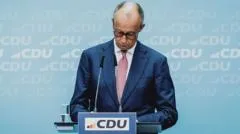
Chancellor Friedrich Merz is currently navigating a profound Friedrich Merz political crisis that threatens to reshape the European landscape. As his popularity ratings plummet to record lows, the political center is rapidly eroding. This decline is compounded by the aggressive surge of the nationalist right, specifically the AfD, which is successfully capturing disillusioned voters. Such domestic volatility in Germany does not merely affect Berlin; it creates a vacuum of leadership within the European Union. As the CDU loses ground, the resulting instability risks paralyzing critical continental decision-making processes and weakening the bloc's collective geopolitical stance.
Why is the Friedrich Merz political crisis affecting Germany so deeply?
The Friedrich Merz political crisis is driven by a historic collapse in public confidence, with the Chancellor's popularity hitting a record low of 13%. This figure represents the poorest approval rating for any German leader since the inception of modern polling. Voters have reacted more swiftly and negatively to Merz's leadership than to any of his predecessors, despite him having been in power for only 16 months.
Much of this resentment stems from a perception that the former corporate lawyer is arrogant and disconnected from the daily struggles of the citizenry. This sense of detachment has been exacerbated by recent electoral failures. Under Merz's leadership, the Christian Democratic Union (CDU) has endured three significant defeats in regional elections within a very short timeframe. Most notably, in Mecklenburg-Vorpommern, the CDU failed to meet the 5% threshold required to enter the regional parliament, a result that underscores the depth of the current political malaise.
The perception of leadership disconnect
The disconnect between the Chancellery and the electorate is not merely about personality; it is about a perceived failure to address fundamental societal shifts. As the CDU loses ground, the traditional 'catch-all' nature of the party is being challenged by more radical alternatives that claim to represent the actual concerns of the German people. This loss of ground is particularly striking given that Merz's popularity fell faster than any predecessor's, leaving him with a wobbly political foundation.
How is the rise of the AfD reshaping the German political landscape?
The Alternative for Germany (AfD) is capitalizing on the CDU's decline, positioning itself as the new dominant force in several regions. While Merz campaigned on a platform of reducing the influence of the nationalist right, the AfD has instead seen spectacular success. The party has become the largest political faction in two of the three most recent state elections and is now positioned to potentially participate in government in Saxony-Anhalt.
Despite being labeled by German authorities as anti-democratic and far-right extremist, the AfD continues to lead in national opinion polls. Following recent electoral gains in Saxony-Anhalt, Mecklenburg-Vorpommern, and Berlin—where the hard-left Die Linke also saw success—AfD co-leader Alice Weidel has claimed that her party has effectively replaced the CDU as Germany's true Volkspartei, or catch-all people's party. The AfD's momentum is built on accusing the current administration of failing to manage the economy and failing to secure streets against immigration concerns. They argue that it is high time for political change.
A challenge to the political center
The AfD's rise represents a direct challenge to the post-war political order in Germany. By claiming the mantle of the 'true' people's party, they are attempting to hollow out the center-right CDU. This shift is particularly sensitive in Germany due to the country's Nazi past, yet the AfD continues to reject the far-right label, insisting that they are simply providing the alternative that voters are demanding.
What economic factors are contributing to political instability?
Germany's economic struggles are a primary driver of voter frustration, as the nation's status as Europe's financial engine begins to falter. The transition from a period of reliable growth to one of uncertainty has left many citizens feeling economically vulnerable. Several structural and geopolitical factors have converged to create this pressure.
The loss of access to cheap Russian energy, which previously fueled German industrial and automotive sectors, has had a profound impact. This energy crisis is compounded by aggressive trade competition from China and the introduction of trade tariffs by the United States under Donald Trump. These pressures are hitting Germany's export-driven model particularly hard, leading to fears regarding future prosperity and living standards. The 'spluttering' economy has failed to meet the promises made by the Merz administration during the election.
- Energy Costs: Germany faces some of the highest energy prices in Europe following the shift away from Russian gas.
- Trade Pressures: Competition from China and US tariff policies are challenging the export-led growth model.
- Economic Growth: The loss of cheap energy and increased global competition have taken a heavy toll on the country's industrial core.
The roots of voter resentment
This economic anxiety is not a new phenomenon but has been building for years. Resentment began to mount significantly after the 2007/8 financial crisis, when traditional parties were seen bailing out big banks while families saw their savings and living standards drop. This sense of being let-down by the center-left and center-right has only intensified as the current economic challenges mount.
How does German domestic instability impact the European Union?
The instability within Germany poses a significant risk to the cohesion of the European Union and the stability of the eurozone. As Europe's largest economy and the biggest net payer into the EU budget, Germany's internal political struggles have immediate external consequences. A weakened German government may be less capable of supporting EU-wide initiatives.
Under current financial pressures, Merz has joined other wealthy EU nations in advocating for a reduction in contributions to the bloc's budget. This pushback comes at a critical juncture when the EU is seeking increased funding for common defense projects, migration management, and technological advancements in AI. If Germany turns inward to manage its own crisis, the entire bloc may struggle to find the leadership and funding necessary to navigate global threats.
Geopolitical vulnerabilities and EU cohesion
The EU is currently facing a period of intense external pressure, including the threat of Russia, economic competition with China, and instability in the Middle East. The unpredictability of US foreign policy further complicates the need for European unity. A fractured Germany, characterized by the rise of both the nationalist AfD and the hard-left Die Linke, complicates the EU's ability to present a united front during this 'bumper election season' across the continent, where nationalist and Eurosceptic parties are predicted to do well.
FAQ: Understanding the German Political Crisis
Why is the CDU losing support in regional elections?
The CDU is losing support due to a combination of leadership dissatisfaction and a failure to address voter concerns regarding the economy and immigration. The party's inability to reach the 5% threshold in Mecklenburg-Vorpommern highlights a significant shift in voter preference toward more radical parties.
What is the AfD's position on being 'far-right'?
The AfD explicitly rejects the 'far-right' label. Instead, the party argues that it represents the true interests of the German people, claiming to have replaced the CDU as the country's primary catch-all party (Volkspartei) following recent electoral successes.
How has immigration influenced German politics?
Immigration, particularly following the 2015 crisis where Germany took in one million people, has become a central political issue. Concerns over integration and security—fueled by headline-making attacks and fears of Islamist extremism—have driven support for the AfD.
What impact does the energy crisis have on Germany?
The loss of cheap Russian energy has significantly increased costs for German industries, particularly in the automotive sector. This has weakened the export-driven economy, contributing to voter resentment and the current political instability under Chancellor Merz.
How does Germany's economy affect the EU budget?
As the largest net payer to the EU budget, Germany's financial health is vital for the bloc. If Germany seeks to slash its contributions due to domestic economic pressure, it could undermine EU funding for defense, AI, and migration.
Key takeaways
- Chancellor Friedrich Merz's popularity has plummeted to a record low of 13%.
- The AfD is gaining significant ground, potentially entering government in Saxony-Anhalt.
- Germany's economy is struggling due to high energy costs and global trade competition.
- German political instability threatens EU funding and collective defense goals.
The future of German stability
The current political climate in Germany suggests a period of prolonged volatility. While Friedrich Merz has called for 'backbone, steadfastness and patience' to implement necessary economic and welfare reforms, the political reality is that his ability to lead is being rapidly eroded. There are even rumors of a brewing palace coup to replace him with a more popular CDU politician, though no candidate has yet stepped forward publicly.
The rise of extremist factions on both the right and left indicates a fundamental shift in the German electorate's priorities. As the country navigates these domestic tensions, the broader European Union must prepare for a period where its traditional anchor of stability is increasingly preoccupied with its own survival. With major elections approaching across France, Italy, Spain, and Poland, the eyes of the world—and the watchful gaze of Beijing and Moscow—remain fixed on Germany's uncertain path.