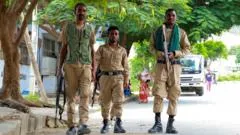
As violent Tigray fighting erupts between regional forces and the national army, fears grow that the fragile peace in northern Ethiopia is rapidly collapsing into a much wider conflict. This sudden escalation threatens to undo years of delicate diplomatic progress and stability in the Horn of Africa. Local observers warn that the breakdown of communication between the federal government and regional leaders could trigger a massive humanitarian crisis. With tensions rising on all sides, the prospect of a full-scale civil war once again looms over the entire nation, leaving many citizens in a state of high alert.
Why has fighting broken out in Tigray again?
The current escalation stems from a breakdown in the relationship between the federal government and the Tigray People's Liberation Front (TPLF) after more than six months of worsening relations. While the 2022 Pretoria Agreement, brokered by the African Union (AU), ended the previous two-year war, several fundamental disputes remained unresolved, acting as tinder for the current violence. Both sides have spent recent months trading accusations and mobilizing troops in preparation for potential engagement.
The immediate trigger for the latest clashes involves a dispute over responsibility for the initial aggression. The TPLF maintains that its actions are a defensive response to a federal offensive that includes the use of drone strikes. Conversely, the Ethiopian government asserts that Tigrayan forces initiated the conflict by seizing control of key airports within the Tigray region. These clashes have not remained localized; they have already begun to spill over into the neighboring Afar and Amhara regions, increasing the risk of a multi-front war.
The human impact of this sudden resurgence is immediate and severe. Residents in Tigray are reporting panic buying, and the disruption of internet and call services has left many unable to access funds via digital apps. This is particularly devastating in a society that has become largely cashless following the failure of ATMs several months ago.
The breakdown of the Pretoria Agreement
The peace deal intended to stabilize the region has faltered due to four primary points of contention. Two of these involve the disputed territory of western Tigray, which was seized by Amhara forces during the previous war. Many in the Amhara region believe this territory should never have been part of Tigray when boundaries were redrawn in 1991. When Amhara fighters seized control during the recent civil war, hundreds of thousands of ethnic Tigrayans fled, and many remain in homeless camps in Tigray and Addis Ababa. The TPLF demands the return of this land and the repatriation of those displaced, while the federal government insists the territory's status must be determined via a referendum.
The second major friction point concerns disarmament. The federal government has accused the TPLF of failing to fully comply with the agreement, alleging that the party has only handed over old weaponry to the AU while hiding its actual arms. This lack of trust regarding military capacity has fueled the current mobilization.
The third issue involves the governance of Tigray. Under the Pretoria Agreement, an interim administration was appointed by Prime Minister Abiy Ahmed. However, attempts by the Prime Minister to influence local affairs led to internal TPLF disputes. Just before the May general election—which was not held in Tigray due to security concerns—the TPLF disbanded the interim administration and restored its pre-war administration. This political shift has had direct economic consequences, as civil servants are no longer being paid and essential services have begun to seize up.
Who are the TPLF?
The TPLF has been a dominant force in Tigray's modern political history. Emerging as an armed movement in the 1970s to fight Ethiopia's military government, it played a central role in the 1991 overthrow of the Marxist regime. For nearly three decades, it was the most powerful component of the Ethiopian People's Revolutionary Democratic Front (EPRDF) coalition. This long period of dominance was contentious, as critics argued the TPLF held disproportionate influence given that Tigrayans make up only about 6% of Ethiopia's population.
The TPLF's power was significantly curtailed in 2018 when Abiy Ahmed became prime minister and replaced the EPRDF with the Prosperity Party. This shift led to a rapid deterioration in relations, culminating in the 2020 war. That conflict was one of the deadliest of the century, with the AU mediator estimating approximately 600,000 deaths. The war also isolated Tigray from the outside world and pushed the region to the brink of famine before the November 2022 truce.
Who is backing the TPLF?
In a significant shift in political dynamics, the TPLF has moved from being politically isolated to forming new alliances. In September, it joined six other armed movements to form the 'Alliance for Survival.' This group includes the Fano militia from the Amhara region and the Oromo Liberation Army. While these groups have different grievances and even conflicting interests—such as the disagreement over western Tigray—they share a common objective: the removal of Abiy Ahmed's government from power.
The alliance represents a tactical move by the TPLF to avoid the isolation they felt in 2020. However, analysts warn that the alliance may be difficult to maintain long-term because the members' ultimate goals and regional interests are fundamentally different.
What is the government's position?
The federal government has responded to the new alliance by portraying it as an attempt to destabilize the country. Beyond blaming the TPLF for the recent fighting, the government has also accused Eritrea of supporting armed groups within Ethiopia, a claim Asmara denies. The relationship between Ethiopia and Eritrea is historically volatile, and the two nations have recently fallen out again.
The tension between Addis Ababa and Asmara centers largely on access to the Red Sea. As the world's most populous landlocked nation, Ethiopia has been pushing for ownership of Eritrea's southern port of Assab. Prime Minister Abiy has even hinted at taking the port by force, adding a layer of international complexity to the domestic conflict.
What do we know about the bombing in Tigray?
Reports indicate that federal forces have utilized drones and other military operations against Tigrayan forces. The government justifies these actions as necessary to defend federal positions and respond to attacks. However, independent verification of individual strikes remains difficult.
In one recently targeted town, residents told the BBC that drones hit two schools. Local officials stated that these schools had been used as military bases by Ethiopian troops during the war, suggesting that the government may believe Tigrayan forces are now using them for similar military purposes. These strikes have also coincided with reports that the TPLF has been forcibly recruiting young men to bolster its ranks.
What is being done to stop the fighting?
Diplomatic efforts are currently focused on de-escalation. The African Union is leading the charge, calling for an immediate cessation of hostilities and a return to direct talks. The AU has tasked its special Horn of Africa envoy, former Nigerian President Olusegun Obasanjo, with engaging the parties. The United Nations has also issued an appeal, warning that a wider conflict could be devastating, while the regional organization Igad has called for a return to dialogue.
Despite these efforts, the path to peace is obstructed by extremely low levels of trust between Addis Ababa and Tigray, compounded by the complexities introduced by the new armed alliance.
Could the fighting spread?
There is a significant risk that the conflict could expand. Fighting has already moved to the borders of Tigray, and the federal government is simultaneously managing armed conflicts in the Amhara and Oromia regions. There is also a looming fear that Eritrea could be drawn into the conflict, potentially on the side against the Ethiopian government.
The situation is further complicated by the civil war in Sudan, where the two primary aggressors hold opposing allegiances regarding the Tigray conflict. The AU has issued specific pleas to neighboring countries to avoid any actions that might escalate the crisis further.
Key Takeaways
- The recent escalation in Tigray involves clashes between the TPLF and the Ethiopian federal army, with fighting spreading to the Afar and Amhara regions.
- The 2022 Pretoria Agreement is faltering due to disputes over the administration of Tigray, the disarmament of TPLF forces, and the status of western Tigray.
- A new 'Alliance for Survival' has formed, bringing the TPLF together with groups like the Fano militia to oppose the current federal government.
- There is a high risk of wider regional conflict involving Eritrea and neighboring states.
Frequently Asked Questions
Why is there fighting in Tigray again?
The fighting is driven by unresolved issues from the 2022 peace deal, including disputes over territory (western Tigray), disarmament, and the governance of the region, alongside recent military escalations.
What is the 'Alliance for Survival'?
It is a new coalition formed in September that includes the TPLF, the Amhara Fano militia, and the Oromo Liberation Army, all sharing the goal of removing the current federal government.
How is the conflict affecting civilians?
Civilians face panic buying, disruption of internet and phone services, and an inability to access money due to the lack of working ATMs in a largely cashless society.