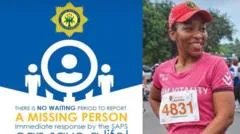
South African police have confirmed the death of runner Elizabeth Moselakgomo whose body was discovered east of Johannesburg. The case forms part of five similar deaths of women in the Kempton Park area. Authorities have issued a public warning while stressing the deaths are not currently linked to a single perpetrator.
What happened to Elizabeth Moselakgomo?
Police confirmed on Monday that the body found on Saturday night belonged to Elizabeth Moselakgomo, a 29-year-old runner reported missing during a routine jog the previous week. Relatives identified the remains. The body was discovered badly bruised and partially clothed in the Kempton Park area east of Johannesburg.
Moselakgomo was a member of a local running club. Colleagues described her as an avid runner known as Tsontso. Her eight-year-old daughter had raised the alarm after she failed to return home. The family later thanked the public for support during the search and highlighted the role of the child in alerting others to the disappearance. Tributes described her as a mother of one who was well known within the running community. The discovery prompted widespread tributes online and in running circles, with many noting her regular participation in club activities and the shock that a familiar face in the local running scene had become the latest victim in a string of grim findings. The family expressed gratitude for the nationwide search efforts that followed her disappearance and noted the particular impact on her young daughter who first noticed she had not come home.
Pattern of five deaths in Kempton Park
Authorities report five women whose bodies have been recovered in the same area, each found half-naked and bruised. Moselakgomo is the latest. Police have formed a task team to investigate the cases. One arrest has been made in connection with the first body; that person remains in custody.
A police statement noted that similarities among the cases are sufficiently concerning to justify a public warning, although investigators have not established a link to a serial offender. Another body was recovered on Monday roughly 25 km away. The latest discovery was made by a passer-by who spotted the remains on the way to work, according to police spokesperson Brig Athlenda Mathe. The grim findings have triggered renewed outrage and fear across the country. The task team continues to examine whether any connections exist between the incidents beyond the shared location and condition of the bodies, while the single arrest remains the only concrete lead reported so far. Investigators continue to review evidence from all five scenes to determine if additional links beyond location and condition can be established.
Police advice and community response
Officers have urged women in the Kempton Park area to avoid walking or running alone, especially in isolated places. Members of the running community expressed fear. Keamo Sefularo told the BBC that the discoveries make everyday activities feel unsafe and stressed the value of running in groups for safety. She described the news as very scary and noted that every woman in South Africa faces constant danger when leaving home for simple tasks such as shopping.
Sefularo added that the disappearance had been heavy for the club and questioned whether Moselakgomo might still be alive had she run with one or three other people. She emphasised that safety in numbers is a standard practice among runners. She also described personal precautions such as varying routes daily and choosing areas with good visibility. Advocacy group Women for Change said the discoveries were angering. Merlize Jogiat asked what purpose protective services serve if women must still protect themselves and blamed poor implementation of existing laws. The group argued that pressure in numbers from citizens offers the best route to change. Community members echoed these concerns, noting that the repeated discoveries have intensified existing anxiety about routine activities and reinforced calls for better coordination between police and local groups. Runners in the area have begun discussing organised group runs and shared route information to increase collective safety.
Scale of gender-based violence in South Africa
South Africa records some of the highest levels of gender-based violence globally. According to UN Women, women are killed at a rate five times higher than the global average. The government has previously declared gender violence a national disaster.
Public reaction on social media highlighted the daily calculations women make about routes, timing and companions. Lesedi Ledwaba wrote on X that women are not free if they must calculate where, when and with whom they can walk, run or exist safely. Tributes to Moselakgomo emphasised her role as a mother and runner while renewing calls for improved safety measures. The pattern of violence has once again placed the national crisis at the centre of public debate, with many pointing to the gap between legislation already on the books and its practical enforcement on the ground. Advocacy voices stress that existing laws alone have not reduced the risks women face in daily movement.
Frequently asked questions
Has a serial killer been identified?
Police have stated they are not linking the deaths to a serial killer at this stage, though similarities prompted a public warning.
How many bodies have been found?
Five bodies of women have been recovered in the Kempton Park area with similar circumstances.
What safety advice has been issued?
Women are advised not to walk or run alone in isolated areas and to consider running in groups or on well-lit routes.
Is there an arrest in the cases?
One person has been arrested in connection with the first body and remains in police custody.
What is the official status of the investigation?
A dedicated task team has been established to investigate the murders.
Key takeaways
Elizabeth Moselakgomo's body was identified on Monday after discovery on Saturday in Kempton Park.
Five women have been found dead in similar circumstances in the same area.
Police have issued a warning but have not confirmed a serial perpetrator.
UN Women data show South Africa's female homicide rate is five times the global average.
One arrest has been made; a task team continues the investigation.
Outlook
The discoveries have renewed public discussion about implementation of existing laws and the daily risks faced by women in South Africa. Families and advocacy groups continue to press for concrete improvements in safety and policing.