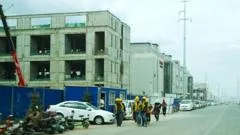
China AI infrastructure is expanding rapidly through the construction of massive data centres in remote provinces to secure computing power for national ambitions. In regions like Inner Mongolia's Ulanqab, huge rectangular blocks are rising alongside traditional farmland to fuel the country's digital frontier. This massive build-out aims to support China's mission to integrate AI into 90% of its industries and society by 2030. This article examines the scale of this infrastructure growth, the strategic shift toward open-source models, the talent landscape, and the socio-economic tensions arising from this technological race.
Why is China rapidly expanding its AI infrastructure?
China is accelerating the construction of massive data centres to secure the computing power necessary to win the global artificial intelligence race. These facilities serve as the backbone for the country's strategic goal to embed AI across 90% of its industrial and social sectors by the year 2030. For the Chinese Communist Party, these physical assets are not merely technological tools but essential pillars of national and economic security.
The scale of construction is particularly visible in sparsely populated provinces such as Inner Mongolia, Ningxia, Gansu, and Guizhou. In Ulanqab, once known primarily as a 'potato capital,' the landscape is being transformed by heavy machinery and large-scale building projects. These sites host infrastructure for major tech players, including Huawei, ByteDance, and DeepSeek. The speed of development is often described by local workers as 'China speed,' characterized by continuous, multi-phase construction cycles designed to keep pace with rapid technological shifts.
Strategic regional selection
The choice of these specific northern and southwestern provinces is driven by several logistical advantages. These areas offer cheaper land and a cooler climate, which naturally reduces the cooling requirements for massive server banks. Furthermore, these regions have significant renewable energy capacity, including wind and solar power, which is critical as China aims for most of its data centres to be powered by green energy by 2030. However, reliance on coal for certain parts of the grid and water scarcity in arid regions like Inner Mongolia remain ongoing environmental challenges.
How does the US-China rivalry influence AI development?
The competition for AI supremacy has created a high-stakes environment where technological progress is viewed through the lens of national survival. US President Donald Trump has signaled a firm stance on maintaining leadership, stating, "Whoever wins AI, wins." This sentiment is echoed by industry leaders like Anthropic CEO Dario Amodei, who has advocated for maintaining bans on the sale of advanced chips and equipment to China, warning that a Chinese lead could pose significant global risks.
In response to these restrictions, China is pursuing a distinct technological path. While US-based firms like OpenAI and Anthropic often utilize 'closed-model' approaches—where design elements and training methodologies are kept secret—China is championing an alternative model. President Xi Jinping has encouraged Chinese firms to develop affordable, open-source models that allow external users and countries to modify the technology as needed.
This open-source strategy serves a dual purpose. First, it fosters rapid innovation by allowing a wider pool of developers to contribute to and build upon existing frameworks. Second, it helps mitigate the impact of US-led semiconductor restrictions. By sharing technology and optimizing software, Chinese firms hope to unlock greater utility from the hardware they currently possess, even if they lack access to the most advanced Western chips.
What is the impact of geopolitical tensions on AI talent?
Shifting geopolitical dynamics are fundamentally altering the global flow of scientific expertise, with more researchers returning to China. As tensions with the United States rise and immigration restrictions tighten, the traditional 'American dream' for Chinese scholars has become less accessible. According to Jack Zhang from the University of Science and Technology of China, there is a clear trend of fewer students heading to the US and an increasing number of researchers returning home.
This influx of talent is supported by high-level recruitment programmes. Many researchers, such as Zhang himself—who studied at Yale and Cambridge—are drawn back by the availability of resources and government support that can be difficult to secure in overseas laboratories. This domestic talent pool is substantial; China produces approximately five million science and technology graduates annually, a figure that dwarfs the roughly half a million produced in the United States.
The culture of innovation vs. conformity
Despite the massive volume of graduates, experts suggest that the quality of innovation is influenced by the domestic academic environment. Professor Liu Jun of Tsinghua University, who has experience at Harvard and Stanford, notes that the system can sometimes reward conformity over the type of critical questioning found in Western institutions. While the ecosystem for interdisciplinary research—combining AI with nuclear fusion, astrophysics, and drug development—is growing, the cultural and systemic pressure to adhere to established norms remains a point of debate among academics.
What are the socio-economic consequences of the AI boom?
The rapid transition to an AI-driven economy is creating a profound divide between the high-tech urban centers and the traditional rural populations. While Beijing views AI as a vital solution to an ageing workforce and a tool to automate manufacturing, the immediate economic reality for many citizens remains unchanged or even precarious. In many regions, the benefits of 'big data' feel disconnected from the lives of ordinary people.
In rural Inner Mongolia, some residents report that the massive data centre projects have brought little direct employment or benefit to local communities. There are also underlying anxieties regarding land rights and the potential displacement of farming families to make room for industrial expansion. While some locals express optimism, noting that their children have found new opportunities in the modern economy, others remain skeptical, feeling that the technological revolution is something happening 'to' them rather than 'for' them.
Economic contradictions in China
The AI expansion is occurring against a backdrop of significant domestic economic challenges. Many Chinese citizens are currently navigating a sluggish economy characterized by rising youth unemployment, low consumer spending, and plummeting property prices. This creates a complex social landscape where the state's massive investments in future-facing technology must coexist with the immediate, pressing needs of a population facing economic uncertainty and demographic shifts.
Frequently asked questions
How does China plan to power its AI expansion?
China is leveraging its vast renewable energy resources, particularly wind and solar power, in provinces like Inner Mongolia and Gansu. The government aims for most data centres to be powered by green energy by 2030, though coal remains a significant part of the current energy mix.
What is the difference between China's and the US's AI models?
The US often employs 'closed-model' approaches, keeping the inner workings of AI secret. In contrast, China is promoting an open-source model, allowing for more flexibility and modification, which helps drive rapid innovation and bypasses some hardware limitations.
Is AI seen as a threat to jobs in China?
Yes, there is growing anxiety regarding job losses as AI is used to automate manufacturing and production. However, the government views this automation as a necessary response to the country's ageing workforce and changing economic structure.
Why are data centres being built in remote areas?
Remote provinces like Guizhou and Ningxia offer cheaper land and cooler climates, which reduces the cost and energy required for cooling servers. These areas also provide better access to renewable energy sources like wind and solar.
How is the talent pool changing in China?
The talent pool is growing as more researchers return from the US to China due to increased geopolitical tensions. China also produces significantly more science and technology graduates annually than the United States.
Key takeaways
- China aims to integrate AI into 90% of its industries and society by 2030.
- Massive data centre construction is accelerating in provinces like Inner Mongolia and Guizhou.
- China is prioritizing open-source AI models to counter US-led chip restrictions.
- The country produces approximately five million science and tech graduates every year.
- The AI boom faces challenges including water scarcity and domestic economic instability.
Conclusion
The rapid expansion of China's AI infrastructure represents a massive strategic undertaking to secure technological sovereignty. By building vast networks of data centres and cultivating a massive domestic talent pool, China is positioning itself to compete directly with the United States. However, this path is not without friction. The tension between high-tech ambitions and rural economic realities, combined with the environmental demands of massive computing power, creates a complex landscape. As the global race for AI supremacy continues, the success of China's model will depend on its ability to balance rapid industrial growth with social and environmental stability.