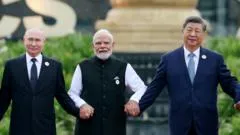
The New Delhi Declaration called for restraint on civilian infrastructure and nuclear sites yet avoided assigning blame or naming participants in either the Middle East conflict or the war in Ukraine.
Why did India host the Brics summit despite regional rivalries?
Indian Prime Minister Narendra Modi welcomed leaders including Chinese President Xi Jinping, Russian President Vladimir Putin, Iranian President Masoud Pezeshkian, Abu Dhabi’s Crown Prince Sheikh Khaled bin Mohamed bin Zayed Al Nahyan and South African President Cyril Ramaphosa. The gathering tested India’s ability to convene states with recent border clashes and opposing roles in Middle East fighting. India and China fought a deadly clash along their disputed frontier in 2020. Iran and the UAE have exchanged missiles and drones during the current conflict. The fact that all attended in person demonstrated Delhi’s diplomatic reach even when natural alliances remain absent. Modi announced that together the leaders should increasingly become rule-shapers rather than rule-takers. The weekend also gave countries a platform to reassess relationships in light of the Iran war, though agreeing on a new global order proved far harder. Veteran Indian diplomat Anil Trigunayat noted that India achieved a push for strategic autonomy in an era of war and initiatives to enhance greater collaboration among members. He emphasised that while some countries would like Brics to become anti-Western, it is not that. Modi himself stated the group is not against anyone, preserving Delhi’s ties with nations at odds with each other. The presence of such divergent actors underscored the diplomatic feat while leaving open how far shared declarations can translate into coordinated action.
How did the New Delhi Declaration handle the Iran war?
The declaration urged maximum restraint and condemned attacks on civilian infrastructure and peaceful nuclear facilities. It reiterated support for a two-state solution and opposed forced displacement of Palestinians or actions that could legitimise occupation, framing these points around existing UN resolutions. No country received explicit mention. Previous Brics statements had named participants in other conflicts; this text deliberately avoided such references. The document listed concerns over indiscriminate rising tariffs and unilateral sanctions but stopped short of naming the United States, likely to avoid Washington’s ire. Analysts observed that the careful wording bore the hallmark of Indian diplomacy. Praveen Donthi of the International Crisis Group noted the strong reference to tariffs as a chance to convey displeasure without direct confrontation. The text therefore condemned unilateral sanctions in general terms only, reflecting the need to reach consensus while side-stepping issues that members sharply disagree on. The absence of blame assignment or specific enforcement mechanisms left the declaration open to differing interpretations by members directly involved in the conflict.
What explains the absence of any Ukraine reference?
The declaration made no mention of Russia’s war in Ukraine, a departure from earlier Brics texts. Members could not agree on language. Twice earlier in the year, Brics ministerial meetings had failed to produce joint statements. The final document therefore side-stepped the most divisive issues to reach consensus. The tension between the desire for a joint text and the reality of sharp divisions ran through the entire summit. China, Russia and Iran view Brics as a vehicle to dilute US and western European power, yet India has resisted casting the group as an explicitly anti-Western bloc. The resulting text therefore focused on general calls for restraint and existing UN resolutions rather than new positions that could fracture the grouping. This omission highlighted the limits of what could be achieved when core members hold incompatible positions on ongoing conflicts.
How did Brics members view Western influence and tariffs?
China, Russia and Iran see the group as a vehicle to dilute US and western European power. India has resisted framing Brics as an explicitly anti-Western bloc. Modi stated the group is “not against anyone.” The declaration listed concerns over indiscriminate rising tariffs and unilateral sanctions without naming the United States. Analysts noted the careful wording reflected India’s wish to avoid direct confrontation while still signalling displeasure. Several members were loath to draw President Donald Trump’s anger after he previously called Brics proposals anti-American. The text therefore condemned unilateral sanctions in general terms only, leaving unsettled how far the group can move toward concrete alternatives without provoking external pressure. The balance struck in the declaration preserved the possibility of continued engagement with Western economies while signalling internal discontent over trade measures.
What bilateral meetings took place on the sidelines?
Iran’s Pezeshkian and Abu Dhabi’s Crown Prince held the highest-level face-to-face talks known between the two countries since the war began. China’s Xi visited Delhi for the first time in seven years. The two sides agreed to strengthen business ties and transport links and to address trade barriers. Xi stayed less than 24 hours and skipped the gala dinner. Official readouts described the atmosphere as cordial but noted persistent mistrust dating from the 2020 border incident. A veteran Indian diplomat observed that there is a will on both sides to work together, yet substantial progress remains to be verified. Iran used the platform to press for deeper economic ties with Brics members including Malaysia, India and Ethiopia while facing US sanctions and naval pressure. The handshake between Xi and Modi lacked the signature hug, underscoring that warming remains gradual. These encounters illustrated the summit’s value as a venue for direct contact even when broader agreements stayed limited.
Frequently asked questions
Did the summit produce concrete economic agreements?
The joint declaration contained general language on trade and sanctions but no new binding commitments or timelines for implementation.
Will Brics create an alternative to Western financial institutions?
Members expressed interest in greater collaboration and strategic autonomy, yet the text offered no specific mechanism or currency proposal.
How long did Xi Jinping remain in Delhi?
President Xi stayed less than 24 hours and did not attend the Saturday evening dinner hosted by Modi.
Was the Iran-UAE meeting announced in advance?
The encounter occurred during the summit; no prior public schedule had listed the bilateral discussion.
What is the next scheduled Brics gathering?
The declaration did not announce a date or location for the following summit.
Key takeaways
The New Delhi Declaration avoided naming any state in the Middle East conflict or in Ukraine. India hosted rivals including Iran and the UAE for the first high-level talks since the war began. China and India agreed to ease trade barriers despite the 2020 border clash. Brics members remain divided on whether the group should become an anti-Western platform. The text condemned rising tariffs without citing the United States.
What comes next for Brics coordination?
The summit created space for rivals to meet outside Western-dominated forums. Members agree a new global order is needed, yet they differ sharply on its shape and the steps required to reach it. Further progress will depend on whether future meetings can move beyond carefully worded declarations to verifiable actions. The harder question remains what exactly should replace existing structures and how to get there.