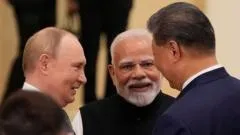
BRICS leaders gather in Delhi this weekend with US President Donald Trump’s tariff threats and the Iran conflict setting the backdrop. The expanded group represents 49% of world population and 40% of global GDP yet internal divisions make a unified stance against Washington unlikely. India as host seeks consensus on financial cooperation and multilateral reforms while managing relations with China and Russia.
Why BRICS avoids direct confrontation with Trump policies
BRICS nations have expanded their economic weight but remain split on how openly to challenge US measures. Russia and Iran favour stronger language, while India pursues a trade agreement with Washington and the UAE hosts American bases. Analysts expect any criticism in the final statement to stay indirect and general rather than explicit.
The group’s recent growth has added members with conflicting views on the global order. This diversity strengthens BRICS numbers yet complicates joint positions on sanctions and currency issues. Host India must balance its own diplomatic priorities with the risk of alienating key partners. Michael Kugelman of the Atlantic Council told the BBC that India cannot afford a joint statement that rails against Washington. He expects any criticism of US policies to be vague and indirect, reflecting the sharply divergent interests within the expanded group.
While Russia and Iran may push for the group to take a clearer stand against President Trump, the geopolitical realities within BRICS are likely to make that difficult. India, which is reportedly in the final stages of a trade deal with the US, will not want a statement that could upset the White House. China, too, may be wary of being seen as using BRICS to target Washington. Then there is the UAE, which has come under Iranian attack during Tehran’s retaliation against US and Israeli strikes. The Gulf state, which hosts US military bases, is unlikely to support a statement that helps Tehran’s cause. Kugelman says BRICS has become more significant through its expansion, but that has also made consensus harder. “You’ve added a number of members that don’t get along,” he said, describing the challenge for India as bringing together countries with “a wide array of views and positions on the global order”.
How BRICS economic achievements compare with institutional limits
The New Development Bank has approved billions of dollars for infrastructure projects, mainly in developing countries. A separate $100 billion contingency reserve arrangement exists to assist members during financial stress, though it has not yet been activated. Leaders will discuss easier local-currency payments, a priority for sanctioned economies such as Russia and Iran.
BRICS accounts for 26% of international trade according to BBC Monitoring analysis. Members also plan to press for reforms at the United Nations, IMF and World Bank to reflect shifting global influence. These efforts align with India’s emphasis on greater representation for the Global South. BRICS’ geopolitical and economic heft has grown substantially over the past decade. While it will be reluctant to take an openly anti-US or anti-Western position, the group will be looking to build on its existing achievements and demonstrate that it can emerge as an alternative to blocs like the G20 and G7.
Trump has also been quite vocal against BRICS, particularly its efforts to reduce global trade’s dependence on the US dollar, commonly known as de-dollarisation. He has often warned the group against trying to come up with an alternative currency or take measures to weaken the dollar’s dominance in global trade. In one such threat, Trump said in November 2024 that BRICS countries would face “100% tariffs” if they backed another currency to replace the “mighty US dollar”. Under these circumstances, what can the group realistically deliver?
What bilateral meetings could deliver during the Delhi summit
Prime Minister Narendra Modi will meet Chinese President Xi Jinping on Saturday as the two countries continue cautious efforts to stabilise ties after earlier tensions. Discussions are expected to cover trade imbalances and border issues without dramatic breakthroughs.
Modi will also hold talks with Russian President Vladimir Putin. The Ukraine conflict and energy cooperation are likely topics, building on Modi’s recent appeal for peace during the Shanghai Cooperation Organisation meeting. Both sides view continued engagement as useful despite differing interpretations of earlier statements. Beyond geopolitics, India’s growing trade deficit with both Russia and China is also likely to feature in the bilateral discussions.
Why India sees high stakes in hosting the expanded group
Delhi aims to reinforce its claim as a voice for developing nations and to deepen links with countries across Africa and Latin America. Success will be measured by a consensus statement and concrete announcements on financial mechanisms rather than rhetorical confrontation with the United States.
India’s experience chairing the G20 in 2023 showed it can secure declarations despite divisions. Foreign ministers earlier failed to agree on a joint text over Iran-related differences, forcing a chair’s summary instead. The current summit offers a chance to demonstrate stronger coordination. The Modi government has placed a strong emphasis on becoming a “leader or a voice of the Global South”, Kugelman says. But India’s efforts have had “limited success” in making deeper inroads in Africa and Latin America, where China has been more successful. With most BRICS members coming from developing economies, Kugelman says the expanded grouping gives India an opportunity to deepen ties with countries such as Ethiopia, Brazil and Indonesia and build a stronger profile across Africa and Latin America.
For Delhi, the test will be whether it can secure a consensus statement — often seen as a measure of a host nation’s diplomatic success. That will be difficult given sharp differences over the Iran war, relations with the US and the future of global trade. The scale of the challenge was evident in May, when BRICS foreign ministers failed to agree on a joint statement after their summit because of differences over the Iran war, leaving host India to issue a chair’s summary instead.
Frequently asked questions
Will BRICS issue a statement criticising US tariffs?
Any language on US policy is expected to remain carefully worded and indirect. Sharp differences among members make open criticism unlikely at this stage.
What financial steps are on the agenda?
Leaders will explore ways to simplify cross-border payments in local currencies and review progress at the New Development Bank and contingency reserve arrangement.
How does the Iran conflict affect the summit?
The UAE’s recent experience with Iranian strikes and its hosting of US bases limit support for statements that could be read as favouring Tehran. Discussions will therefore stay measured.
Can BRICS reduce reliance on the US dollar?
De-dollarisation efforts continue but face strong warnings from Washington. Concrete alternatives remain limited and no major announcement is anticipated this weekend.
What does the summit mean for India’s global role?
Success would help Delhi reassert diplomatic weight after Pakistan’s recent profile in Middle East mediation. A smooth outcome would also strengthen India’s leadership credentials within the Global South.
Key takeaways
BRICS represents 49% of world population and 40% of global GDP yet struggles with internal divisions over US policy.
The New Development Bank has funded multiple infrastructure projects in developing nations.
India seeks a consensus statement and new financial cooperation measures during its host summit.
Bilateral meetings between Modi, Xi and Putin will address trade and regional conflicts without expecting major breakthroughs.
Any final language on Washington is likely to stay indirect because of differing member interests.
Outlook for BRICS influence after Delhi
The summit is expected to produce measured announcements on payments and development finance while avoiding direct challenges to US measures. For India, a credible outcome would reinforce its multilateral ambitions and demonstrate that an expanded BRICS can function despite divergent views. Washington will monitor the results closely as the group continues to position itself as an alternative platform for emerging economies. Kugelman says the stakes are particularly high for India at this summit. Delhi, he argues, has been somewhat overshadowed by Pakistan’s recent diplomatic role in the Middle East, including its involvement in mediation efforts around the Iran war. “This is an important opportunity for India to reassert its global significance and its global leadership,” he says. “That is one reason why the stakes are high.” The summit, he adds, is in some ways “more important for India as host than it is for the BRICS grouping as a whole”.