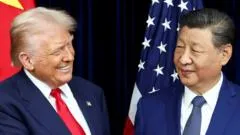
The AI race between US and China has reached a critical juncture as President Donald Trump and President Xi Jinping meet to discuss technological supremacy. While the US currently maintains a lead in frontier models, China is aggressively pursuing a strategy of economic ubiquity through open weight models and robotics. According to researchers at Stanford University, as of March 2026, the top US model led the field by just 2.7%. This competition spans advanced microchip access, energy costs, and the pursuit of Artificial General Intelligence (AGI). This article examines the divergent technological strategies, regulatory approaches, and the geopolitical implications of the struggle for AI dominance.
How do the US and China differ in their AI development strategies?
The competition is defined by two fundamentally different philosophies of technological deployment and accessibility. The United States focuses on the development of high-performance 'frontier models'—proprietary systems that require massive capital investment and are typically accessed through paid subscriptions or specific corporate platforms. This model is driven by a booming stock market and the immense profitability projected for leading AI labs.
In contrast, China has pivoted toward a strategy of widespread economic integration. Rather than focusing solely on the absolute highest-performing proprietary systems, Chinese firms are releasing 'open weight models.' These are downloadable and adaptable, allowing for rapid customization across various industries. This approach aims to make AI a ubiquitous tool within the Chinese economy.
The divergence in model accessibility
The distinction between proprietary and open weight models is central to the current rivalry. US firms like OpenAI, Google, and Anthropic invest heavily in closed ecosystems. While these systems set the global benchmarks, they remain behind expensive paywalls. Meanwhile, Chinese models such as Moonshot AI’s Kimi K3 have gained international traction by offering high performance in a freely downloadable format. As Lizzi Lee from the Asia Society Policy Institute notes, while the US leads at the technological frontier, China may gain significant geopolitical leverage by making capable AI cheap and accessible to a broader range of users.
What is the current state of the technological lead?
Measuring who is winning the AI race depends entirely on the metrics used, as both nations hold distinct advantages. The US maintains a narrow lead in raw computational intelligence and frontier model performance. According to Stanford University researchers, the gap between the top US model and its closest rivals was only 2.7% as of March 2026.
However, China is closing the gap through alternative methods and manufacturing dominance. Despite significant hurdles, Chinese developers have shown what Lian Jye Su of Omdia describes as remarkable resilience and innovation. This includes the use of 'distillation'—a technique where models learn from more advanced platforms to replicate high-level reasoning without requiring the same level of initial training resources.
Manufacturing and energy advantages
China’s competitive edge extends beyond software into the physical infrastructure required to sustain AI growth. Two key areas provide Beijing with a strategic advantage:
- Robotics: China has established itself as the world's premier manufacturer of robotic systems. The International Federation of Robotics estimates there are more than two million robots working in Chinese factories. Furthermore, Chatham House reports that China accounted for over 90% of global humanoid robot shipments in the first half of 2026.
- Energy Costs: AI training and operation are incredibly energy-intensive. Rebecca Arcesati of the Mercator Institute for China Studies highlights that Chinese AI companies benefit from significantly lower electricity costs, providing a structural advantage in scaling large-scale operations.
How have chip restrictions impacted the competition?
The US government has implemented sweeping restrictions on the export of advanced microchips to Chinese firms, a move intended to slow China's progress in developing cutting-edge AI. These chips are the essential hardware required to train the most sophisticated models, and the denial of access creates a significant bottleneck for Chinese research labs.
Despite these barriers, the impact has not been a total halt in Chinese progress. The industry continues to see new model releases on a monthly basis. US officials have alleged that Chinese developers are bypassing some of these limitations through clever software engineering, such as the aforementioned distillation techniques, which allow them to squeeze higher performance out of less advanced hardware.
How do the two nations approach AI safety and regulation?
The regulatory landscape reveals a stark contrast in how each superpower views the risks associated with artificial intelligence. The US approach, particularly under the Trump administration, priorities rapid innovation and minimal government interference to ensure American labs remain ahead of global competitors.
President Trump has characterized many existential risks associated with AI as a "hoax," suggesting that the primary guardrails needed are strong leadership rather than heavy regulation. This "hands-off" approach is intended to prevent the stifling of a technology that is expected to be as transformative as the Industrial Revolution.
Centralized control vs. innovation-led growth
Beijing has opted for a more centrally coordinated and cautious regulatory framework. President Xi Jinping has emphasized the necessity of keeping AI "under human control," leading to the implementation of early guidelines regarding data usage and algorithmic transparency. According to Jayant Dave of Check Point Software Technologies, while these guidelines may not be legally binding in the same way as Western laws, they set clear expectations for developers. This allows the Chinese government to manage potential threats to domestic stability and prevent the misuse of technology in ways that could disrupt social order.
Is international cooperation possible amidst the rivalry?
While the competition is fierce, there are emerging signals of a desire to manage the risks of a technological catastrophe. Recent discussions between US Treasury Secretary Scott Bessent and Chinese Vice Premier He Lifeng focused on creating a notification mechanism for serious AI-related incidents. This suggests that even in an era of high tension, both sides recognize the need for basic communication channels.
However, the underlying motivations for cooperation remain mismatched. As noted by industry experts, Washington’s primary concern is the risk of AI capabilities escaping human control, whereas Beijing is focused on preventing AI from threatening its internal stability. This fundamental difference in perception makes a unified global governance framework for AI difficult to achieve. The challenge for the upcoming Trump-Xi summit will be to prevent the "race narrative" from escalating into an uncontrolled confrontation that could destabilize global security.
Frequently asked questions
What is the difference between frontier models and open weight models?
Frontier models are high-performance, proprietary systems developed by companies like OpenAI or Google, typically accessed via paid subscriptions. Open weight models, which China is prioritizing, are downloadable and can be modified by users, making them more accessible and easier to integrate into diverse economic sectors.
How are chip restrictions affecting China's AI development?
US restrictions prevent Chinese firms from purchasing the most advanced microchips necessary for training top-tier AI. While this creates a significant hurdle, Chinese developers are responding with innovation, using techniques like distillation to achieve high performance on more modest hardware.
Why is energy a factor in the AI race?
Training and running large-scale AI models requires massive amounts of electricity. China's ability to provide lower-cost electricity to its AI firms gives it a structural cost advantage over competitors, allowing for more efficient scaling of large-scale computing operations.
What is Artificial General Intelligence (AGI)?
AGI refers to a theoretical form of artificial intelligence that possesses the ability to learn, reason, and perform any intellectual task at or above the level of a human being. Both the US and China are racing to achieve this milestone.
How does China lead in robotics?
China is the world's largest manufacturer of robots, with millions in use in its factories. It also dominates the humanoid robot market, producing more than 90% of the world's shipments in early 2026.
Key takeaways
- The US leads in frontier model performance, with a 2.7% advantage over rivals as of March 2026.
- China is pursuing an "open weight" strategy to make AI ubiquitous and cheap across its economy.
- China dominates the humanoid robot market, accounting for over 90% of global shipments.
- US policy focuses on deregulation to spur innovation, while China emphasizes centralized human control.
Conclusion
The AI race between the US and China is no longer just a software competition; it is a multifaceted struggle involving hardware, energy, robotics, and regulatory philosophy. While the US holds the edge in cutting-edge intelligence, China’s focus on open-source accessibility and manufacturing dominance provides a powerful counterweight. As both nations navigate the tension between rapid innovation and safety, the outcome of their bilateral engagement will determine whether the world moves toward a cooperative era of AI governance or an era of escalating technological fragmentation.